Showing posts with label Mary. Show all posts

Sunday, March 25, 2012

Feast of the Annunciation


"Mary became the Mother of God at the moment of the Incarnation. It was a moment for which God had richly prepared her. Through the fullness of grace which He gave her, Mary had lived a life of obedience to the will of God. Her every thought and action had been formed in the burning crucible of charity or the love of God. She had even conceived the resolution to devote herself to the service of God by a vow of virginity. At the moment chosen by God, the Archangel Gabriel appeared to her in bodily form and announced to her the great purpose for which God had chosen her. 'Hail, full of grace,' he said, and his words signified her worthiness to fulfill the role for which she was destined. 'The Lord is with thee,' he continued, and in these words he announced the conception that was to take place. When Mary gave full consent of her loving, obedient heart in the words, 'Be it done unto me according to thy word,' the marriage between God and human nature was complete. God had become man, and in the consent of Mary all mankind consented to its own ennoblement in the God-man, Christ. Eve had seduced Adam to the destruction of the human race. Mary conceived Christ for the salvation of the human race."

-- My Way of Life: The Summa Simplified for Everyone by  Walter Farrell, OP, STM, and Martin J Healy, STD

** The painting is by Fra Angelico.

Wednesday, July 6, 2011

Precious Blood Prayer to the Mother of God


Dear Mother of God and purest virgin, do offer to the Heavenly Father the Precious Blood and merits of Jesus Christ for all poor sinners and for the prevention of mortal sin.

Dear Mother of God and Protectress of the Holy Church, do offer to the Heavenly Father the Precious Blood and Merits of Jesus Christ for our Holy Mother Church, for our Holy Father the Pope and his intentions, for our Bishop and his diocese.

Dear Mother of God, and my Mother also, do offer to the Heavenly Father the most Precious blood and the merits of Jesus Christ, His most holy and Divine Heart, and His infinite merits, for our cruelly persecuted brethren in every land where Christians suffer persecution. Offer them also for the unhappy pagans that they may learn to know Jesus, Thy Son, and their Redeemer, and for the liberty, victory, and extension of the Catholic Faith in all the countries of the world. Obtain also for the newly converted fidelity and constancy in our holy Faith. Amen.

Thursday, February 17, 2011

The Mother of God asks for our collaboration

"Modern times will be dominated by Satan and the future will be even more so. The combat against Hell cannot be carried out by men and women alone, even the most intelligent ones. Only the Immaculate has received the Promise of the Victory over the Demon from God.

However, since she was raised to Heaven, the Mother of God asks for our collaboration. She seeks souls that will be devoted entirely to her and become efficient and sure instruments between her hands, to inflict Satan’s defeat and establish God’s reign on this earth."

-- St Maximilian Kolbe


Notre-Dame des Victoires, priez pour nous!

Friday, February 11, 2011

Our Lady of Lourdes

Rejoice, flower of incorruptibility;
Rejoice, crown of continence!
Rejoice, Thou from whom shineth the Archetype of the Resurrection;
Rejoice, Thou Who revealest the life of the angels!
Rejoice, tree of shining fruit, whereby the faithful are nourished;
Rejoice, tree of goodly shade by which many are sheltered!
Rejoice, Thou that has carried in Thy womb the Redeemer of captives;
Rejoice, Thou that gavest birth to the Guide of those astray!
Rejoice, supplication before the Righteous Judge;
Rejoice, forgiveness of many sins!
Rejoice, robe of boldness for the naked;
Rejoice, love that doth vanquish all desire!
Rejoice, O Bride Unwedded!

-- Romanos the Melodist


Thursday, February 10, 2011

Call upon Mary

"In dangers, in doubts, in difficulties, think of Mary, call upon Mary. Let not her name depart from your lips, never suffer it to leave your heart. And that you may more surely obtain the assistance of her prayer, neglect not to walk in her footsteps. With her for (your) guide, you shall never go astray; while invoking her, you shall never lose heart; So long as she is in your mind, you are safe from deception; while she holds your hand, you cannot fall; under her protection you have nothing to fear; if she walks before you, you shall not grow weary; if she shows you favor, you shall reach the goal."

-- St Bernard of Clairvaux

Saturday, January 29, 2011

O Beata Virgo Maria

O blessed Virgin Mary, who can worthily repay thee thy just dues of praise and thanksgiving, thou who by the wondrous assent of thy will didst rescue a fallen world? What songs of praise can our weak human nature recite in thy honor, since it is by thy intervention alone that it has found the way to restoration? Accept, then, such poor thanks as we have here to offer, though they be unequal to thy merits; and, receiving our vows, obtain by thy prayers the remission of our offenses.

Carry thou our prayers within the sanctuary of the heavenly audience, and bring forth from it the antidote of our reconciliation. May the sins we bring before Almighty God through thee, become pardonable through thee; may what we ask for with sure confidence, through thee be granted.

T ake our offering, grant us our requests, obtain pardon for what we fear, for thou art the sole hope of sinners. Through thee we hope for the remission of our sins, and in thee, O blessed Lady, is our hope of reward. Holy Mary, succour the miserable, help the fainthearted, comfort the sorrowful, pray for thy people, plead for the clergy, intercede for all women consecrated to God; may all who keep thy holy commemoration feel now thy help and protection.

B e thou ever ready to assist us when we pray, and bring back to us the answers to our prayers. Make it thy continual care to pray for the people of God, thou who, blessed by God, didst merit to bear the Redeemer of the world, who liveth and reigneth, world without end.

Amen.

-- Written by Bishop Fullbert of Chartres (ca 951- ca 1029)

-o-

This prayer has been incorrectly attributed to St Augustine.

Remember, Saturdays are traditionally dedicated to Our Lady. :)

Wednesday, January 19, 2011

Dedication to Mary, Our Mother


Pray for us ever, Holy Mother of God.
Pray for us, whatever be our cross,
as we pass along our way.
Pray for us, and we shall rise again,
though we have fallen.
Pray for us when sorrow,
anxiety or sickness comes upon us.
Pray for us when we are prostrate
under the power of temptation.

-- Composed by John Henry Cardinal Newman

Monday, October 11, 2010

Maternity of the Blessed Virgin Mary


"His Mother was chosen a Virgin of the kingly lineage of David, and when she was to grow heavy with the sacred Child, her soul had already conceived him before her body.  She learned the counsel of God announced to her by the Angel, lest the unwonted events should alarm her.  The future Mother of God knew what was to be wrought in her by the Holy Ghost, and that her modesty was absolutely safe.  For why should she, unto whom was promised all sufficient strength through the power of the Highest, have felt hopeless merely because of the unexampled character of such a conception?  She believeth, and her belief is confirmed by the attestation of a miracle which hath already been wrought.  The fruitfulness of Elizabeth, before unhoped for, is brought forward that she might not doubt that he who had given conception unto her that was barren, would give the same unto her that was Virgin.  And so the Word of God, the Son of God, who was in the beginning with God, by whom all things were made, and without whom was not anything made that was made, to deliver man from eternal death, was made man.

Our Lord Jesus Christ, descending from his throne in heaven, but leaving not that glory which he hath with the Father, cometh into this lower world by being born after a new order and in a new birth.  He cometh after a new order, in that he who is unseen among his own, was seen among us; the Incomprehensible was fain to be comprehended, and he that is from everlasting to everlasting began to be in time.  He was the Offspring of a new birth; conceived of a maiden, without the passion of any fleshly father, without any breach of his Mother's virginity, since such a birth beseemed the coming Saviour of mankind, who was to have in him the nature of man's being, and to be free of any defilement of man's flesh.  Though he sprung not as we spring, yet is his nature as our nature; we believe that he is free from the use and custom of men; but it was the power of God which wrought that a maiden should conceive, that a maiden should bring forth, and yet abide a maiden still."

-- From a sermon by St Leo the Great

** This feast is observed by all following the 1962 traditional liturgical calendar

Friday, September 24, 2010

Our Lady of Ransom

"In the early part of the thirteenth century of the era of our Lord, the greatest and fairest part of Spain lay crushed under the yoke of the Saracens, and countless numbers of the faithful were held in brutal slavery, with the most lively danger of being made to deny the Christian faith and of losing everlasting salvation.  Amid such sorrows the most Blessed Queen of heaven came mercifully to the rescue, and shewed how the greatness of her motherly love was fain for their redemption.  Holy Peter Nolasco, in the full bloom of the treasures of godliness as well as rich in earthly wealth, was earnestly pondering with himself how he could succour so many suffering Christians dwelling in bondage to the Moors.  To him appeared with gracious visage the Most Blessed Virgin, and bade him know that it would be well-pleasing in her own sight, and in the sight of her Only-begotten Son, that an Order of Religious men should be founded in her honour, whose work it should be to redeem prisoners from Mohammedan slavery.  Strengthened by this heavenly vision, the man of God began to burn with wonderful charity, nursing in his heart the one desire that he himself and the Order which he should found might exercise that love, greater than which hath no man, that a man lay down his life for his friends.

Upon the same night the same most holy Virgin appeared to the Blessed Raymund de Pennafort, and to James, King of Aragon, charging them concerning the founding of the Order, and desiring them to help in raising up so great a work.  Peter betook himself forthwith to the feet of Raymund, who was his confessor, and laid the matter before him, whom also he found taught from heaven, and to whose governance he right humbly submitted himself.  Then came King James, who appointed to carry out this revelation, which himself also had received from the Most Blessed Virgin.  The three took counsel together, and all with one consent entered upon the institution of an Order in honour of the said Virgin Mother, to be placed under the invocation of St. Mary of Ransom, for the Redemption of Captives.

Upon the 10th of August, in the year of our Lord 1218, the above-named King James decreed the establishment of this Order, thus already conceived by these holy men.  The brethren take a fourth vow, whereby they bind themselves to remain in pawn with the unbelievers, if need so require, for the liberation of Christians.  The King granted them the right to bear on their breasts his own Royal blazon, and obtained from Gregory IX the confirmation of this Institute and Order so nobly marked by brotherly charity.  God himself, through the Virgin Mother, gave the increase, causing this Institute speedily and prosperously to spread through all the world, and to blossom with holy men, great in love and godliness, to spend in the redemption of their neighbours the alms which are committed to them by Christ's faithful people, to that end, and some whiles to give themselves up for the ransom of many.  That due thanks might be rendered to God and to the Virgin Mother for the great blessing of this Institute, the See Apostolic among  other well-nigh countless favours bestowed upon it, permitted that this special Feastday should be kept and this Office said."

-- From the 1911 Breviary of St Pius X (1950 ed)

-o-

Mother of Mercy, Our Lady of Ransom, pray for us sinners, and obtain for us the conversion of all souls to the true Catholic Faith, that we may share with you the joys of Heaven. Amen.

Wednesday, September 8, 2010

The Nativity of the Blessed Virgin Mary


Vouchsafe that I may praise thee, O sacred Virgin; give me strength against thine enemies, and against the enemy of the whole human race. Give me strength humbly to pray to thee. Give me strength to praise thee in prayer with all my powers, through the merits of thy most sacred nativity, which for the entire Christian world was a birth of joy, the hope and solace of its life.

When thou wast born, O most holy Virgin, then was the world made light.

Happy is thy stock, holy thy root, and blessed thy fruit, for thou alone as a virgin, filled with the Holy Spirit, didst merit to conceive thy God, as a virgin to bear Thy God, as a virgin to bring Him forth, and after His birth to remain a virgin.

Have mercy therefore upon me a sinner, and give me aid, O Lady, so that just as thy nativity, glorious from the seed of Abraham, sprung from the tribe of Juda, illustrious from the stock of David, didst announce joy to the entire world, so may it fill me with true joy and cleanse me from every sin.

Pray for me, O Virgin most prudent, that the gladsome joys of thy most helpful nativity may put a cloak over all my sins.

O holy Mother of God, flowering as the lily, pray to thy sweet Son for me, a wretched sinner. Amen.

-- Prayer in honor of Our Lady's Nativity written by St Anselm

-o-

Happy birthday, Blessed Mother!

** Painting by Murillo

Sunday, August 22, 2010

The Immaculate Heart of Mary

"What man, unless secure in a divine oracle, may presume to speak with impure, indeed with polluted lips, anything little or great about the true Parent of God and of man, whom the Father before all ages predestined a perpetual Virgin, whom the Son chose as his most worthy Mother, whom the Holy Ghost prepared as the dwelling place of every grace?  With what words shall I, a lowly man, give expression to the highest sentiments of the virginal Heart uttered by the holiest mouth, for which the tongues of all the Angels do not suffice?  For the Lord saith: A good man bringeth forth good things from the good treasure of his heart; and this word can also be a treasure.  Among pure mortals who can be conceived of as better than she who was worthy to be the Mother of God, who for nine months had as a guest in her heart and in her womb God himself?  What better treasure than the divine love itself, which was burning in the Heart of the Virgin as in a furnace?

And so, from this Heart as from a furnace of divine ardour the blessed Virgin brought forth good works, that is, words of the most ardent charity.  For as from a vessel full of the richest and best wine only good wine can be poured; or as from a furnace of intense heat only a burning fire is emítted; so indeed from the Mother of Christ no word can go forth except of the greatest and most intense divine love and ardour.  It is also the mark of a wise woman and matron to speak few words, but words  that are effective and full of meaning; and so seven times, as it were, seven words of such wonderful meaning and virtue are read as having been uttered  by the most blessed Mother of Christ, that mystically it may be shewn she was full of the sevenfold grace.  To the Angel twice only did she speak; to Elizabeth also twice; with her Son likewise twice, once in the temple, and a second time at the marriage feast; and once to the attendants.  And on all those occasions she always said very little; with this one exception that she spake at length in the praise of God and in thanksgiving, namely, when she said: My soul doth magnify the Lord.  But here she did not speak with man, but with God.  Those seven words were spoken in a wonderful degree and order according to the seven courses and acts of love; as if they were seven flames from the furnace of her Heart."

-- From a sermon by St Bernardine of Siena

** The Traditional Liturgical Calendar observes this feast day in honor of Our Lady today.

Mater Immaculata, ora pro nobis!

Sunday, August 15, 2010

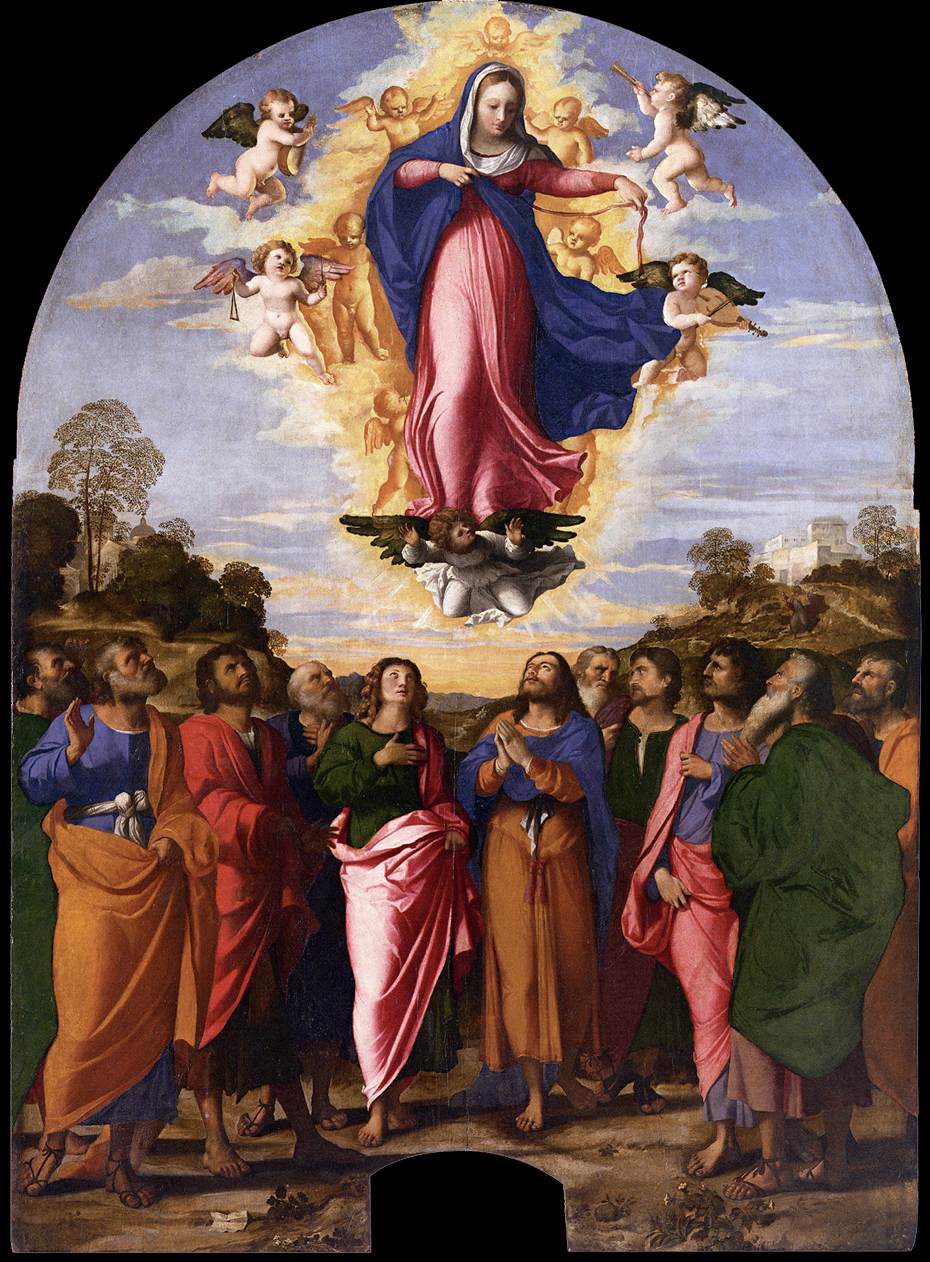
The Assumption of the Blessed Virgin Mary


"Since indeed the universal Church hath at all times and throughout the ages manifested faith in the bodily Assumption of the Blessed Virgin Mary, and since the Bishops of the whole world by an almost unanimous agreement have petitioned that this truth, which is enshrined in Sacred Scripture and deeply rooted in the souls of Christ's faithful, and is also truly in accord with other revealed truths, should be defined as a dogma of the divine and Catholick Faith, Pope Pius XII, acceding to the requests of the whole Church, decreed that this privilege of the Blessed Virgin Mary be solemnly proclaimed, and thus, on the first day of November of the year of the Great Jubilee, nineteen hundred and fifty, at Rome, in the open square before the Basilica of St. Peter, surrounded by a throng of many Cardinals and Bishops of the Holy Roman Church who had come from distant parts of the earth, and before a great multitude of the faithful, with the whole Catholick world rejoicing, proclaimed in these words and with infallible statement the bodily Assumption of the Blessed Virgin Mary into heaven: Wherefore, having offered to God continual prayers of supplication, and having invoked the light of the Spirit of Truth, to the glory of Almighty God who hath enriched the Virgin Mary with his special favour; in honour of his Son, the immortal King of ages and victor over sin and death; for the increase of the glory of the same august Mother, and for the joy and exultation of the whole Church, by the authority of Our Lord Jesus Christ, of the holy Apostles Peter and Paul, and by our own authority, we pronounce, declare and define it to be a divinely revealed dogma that: The Immaculate Mother of God, Mary ever Virgin, was, at the end of her earthly life, assumed body and soul into heavenly glory."

-- From the Acts of Pope Pius XII


** Painting by Palma Vecchio

Thursday, August 5, 2010

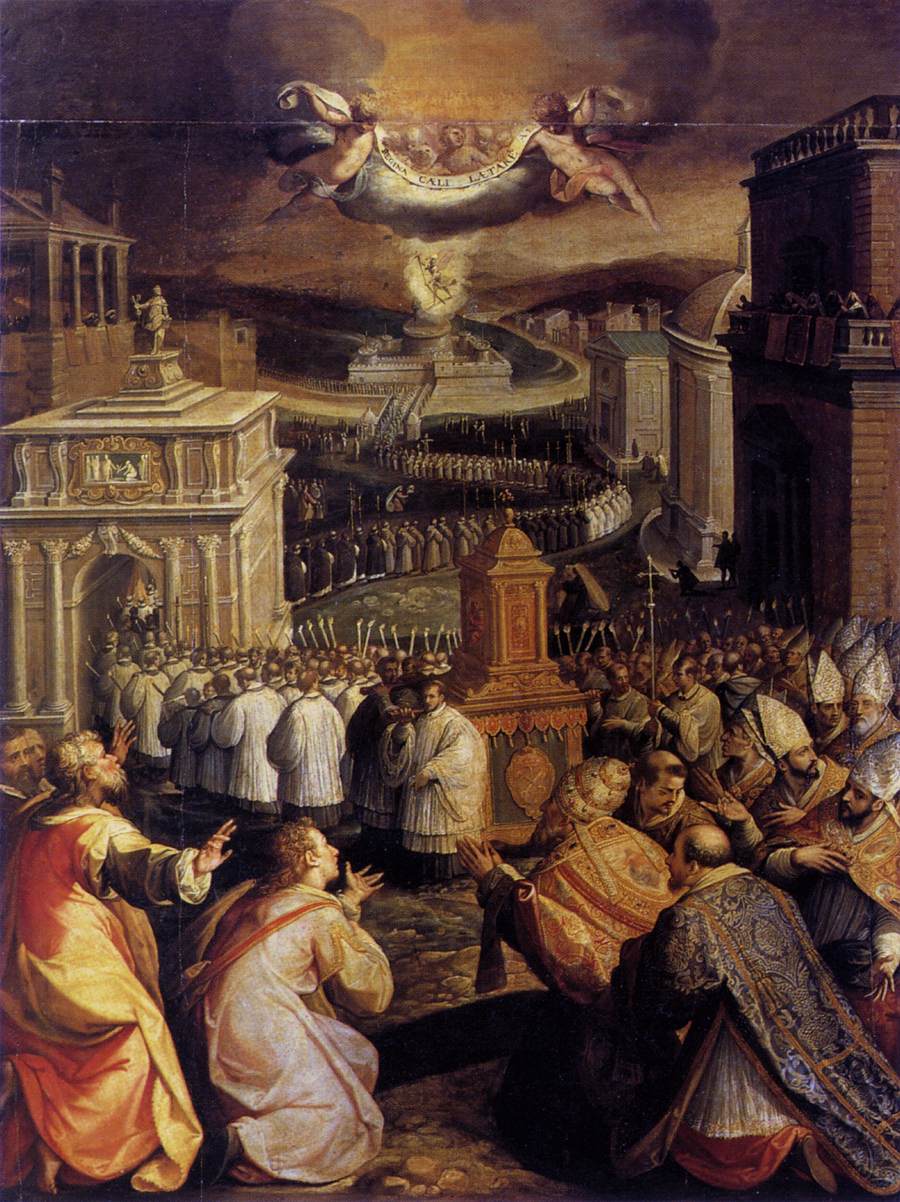
Dedication of Our Lady of the Snows


"In the time of Pope Liberius, there lived at Rome a certain nobleman named John and a noble lady his wife, who had no children to whom to leave their substance.  Then they vowed that they would make the most holy Virgin Mother of God their heiress, and earnestly besought her in some way to make known to them upon what godly work she would that the money should be spent.  The blessed Virgin Mary graciously listened to their prayers and heartfelt earnestness, and by a miracle assured them of her will.

On the 5th day of August, which is that time when the heat of summer waxeth greatest in Rome, a part of the Esquiline Hill was covered by night with snow.  And on this same night the Mother of God appeared in a dream to John and his wife separately, and told them that on that spot, which in the morning they should see clad with snow, they should build a Church, to be dedicated in the name of the Virgin Mary, for that this was the way in which she chose that they should make her their heiress.  John went and told it to Pope Liberius, who declared that he also had been visited by a like dream.

Therefore he came in a solemn procession of Priests and people to the snow-clad hill, and traced upon that spot the plan of a Church which was built with the money of John and his wife.  It was afterwards rebuilt by Sixtus III.  At the beginning it was called by divers names, sometimes the Liberian Basilica, sometimes the Church of St. Mary-at-the-Manger.  Howbeit, since there are in Rome many Churches called after the Holy Virgin Mary, and this Church doth excel them all, both in honour, and because of the strange sign wherewith it was dedicated, it hath come to be called the Church of St. Mary Major.  The memory of the dedication thereof is kept every year by a Feastday that taketh name from the wonderful fall of snow which on this day took place."

-- From the 1911 Breviary of St Pius X

** Painting  by Jacopo Zucchi

Friday, July 2, 2010

The Visitation of the Blessed Virgin Mary


"As soon as our Redeemer was come among us, he went with haste, while as yet he was in his mother's womb, to visit his friend John.  And John, in the one womb, as if conscious of the presence of Jesus in the other womb, dashed himself impatiently against the narrow walls of his natural prison, as though crying out: I perceive the very Lord that gave nature her bounds!  Why therefore should I wait for the due season of my birth?  What need is there for me to linger here till nine months are ended, now that the Timeless One is with me!  I would break out of my dark cell!  I would proclaim my manifold knowledge of marvellous things!  I am meant to be a sign, and so even now I would shew that the Christ is here!  I am the trumpet-voice, and I desire to peal forth the news that the Son of God is come in the flesh. Let me sound as a trumpet, and bless and loose my father's tongue, and make it speak again!  Let me sound as a trumpet and quicken my mother's womb!

Thou seest, O brethren beloved, how new and how strange a mystery is here!  John is not yet born, but by leaping he speaketh.  He is as yet unseen, but he giveth warning.  He is not yet able to cry, but by his acts he beareth witness.  He draweth not yet the breath of life, but he preacheth God.  He seeth not yet the light, but he maketh known the Sun.  He is not yet come out of the womb, but he hasteth to play the Forerunner.  In the presence of the Lord he cannot restrain himself, but rebelleth against the bounds set by nature, and struggleth to break out of the prisoning womb, eager to herald the coming Saviour.  He saith, as it were: Behold, the Deliverer cometh, and why am I yet in bonds, and made to abide here?  The Word cometh, that he may set right all things, and am I still to tarry in prison?  I would go forth!  I would run before him, and proclaim to all mankind: Behold the Lamb of God that taketh away the sin of the world.

But do thou tell us, O John, how it came to pass that while thou wast still in the darkness of thy mother's womb, thou didst see and hear?  How didst thou behold the things of God?  How didst thou leap and bound for joy?  If we could hear him answer, he would say: Great is the mystery of that which here taketh place.  Beyond the understanding of men are these doings!  It is meet that I should shew forth a new thing in nature for the sake of him who is making new things which are beyond nature.  Even though I be yet in the womb, I perceive, for forth upon me from another womb the Sun of Righteousness shineth.  As it were, with mine ears I understand, for I was created to be the Voice of the Great Word.  I would cry aloud, for I contemplate the only-begotten Son of the Father clothed in flesh.  I tremble for joy, for I perceive that he, by whom all things were made, hath taken upon him the form of a servant.  I leap as I think of the Redeemer of the world being made flesh, for I would run before his coming.  Nonetheless, I herald his approach unto you as best I can, and make on this wise my confession of him whose Forerunner I am."

-- From a sermon by St John Chrysostom

** Painting by Juan Correa del Vivar

Thursday, May 20, 2010

Our lives must give birth to Jesus’ presence in our world


"Mary can be called blessed around the world because she looks familiar to every culture and society and race and nationality. Yet, Mary’s mission and message remain firmly focused on the Lord. The challenge for us is to do the same: to be open and to accept every culture and race, even within our own society and nation and neighbourhood. Jesus' command is exact: “Do for others just what you want them to do for you” (Lk. 6:31). Jesus never promises that we will always like what we have to do for others; sometimes it may be difficult, unpleasant, or inconvenient. Jesus addresses the way we desire to be treated when we need something done for us. But he also highlights the implications of our treatment of others: “Whatever you did to one of the least of these, you did to me... Whatever you did not do for one of the least of these, you did not do for me” (Mt. 25:40,45).

To the degree that we can adapt, we become people for the world, we bring Jesus to the world. Our adaptability will be most evident in our daily lives and work. It is relatively easy to be sensitive to the plight of other people and cultures as we see their struggle on television or read it in the newspapers. The true challenge of adaptability is to have that same sensitivity toward the people we encounter every day. Adapting and adjusting to family members, friends, co-workers provide us with ample opportunities to confirm or compromise the integrity of our spiritual journey. The prejudices with which we can classify all members of a particular group or age or race, or the many “isms” with which we can categorize people and strip them of individuality and even dignity, diminish our capacity for sensitivity and adaptability.

Mary had the unique privilege to become the Mother of God, to give birth to Jesus, to be the means by which God became part of our world. Our lives must give birth to Jesus’ presence in our world; our actions must continue his mission. We must live the example of Jesus among others. Then we will be people who adapt, people for the world. Then we, too, can be called blessed."

-- Learning from Mary in her own words: wisdom for the spiritual journey by Joel Giallanza, csc

Thursday, May 13, 2010

Our Lady of Fatima


In our Diocese we observe the Ascension of Our Lord today but I couldn't resist a little something on Our Lady of Fatima. In honor of Our Lady's request, please remember to pray the Rosary in her honor and in reparation for the offenses committed against her Immaculate Heart.

Our Lady of Fatima, pray for us!

Saturday, February 27, 2010

Mary comes to a heart that wants to love her

"Love Mary! She is lovable, faithful, constant. She will never let herself be outdone in love, but will ever remain supreme. If you are in danger, she will hasten to free you. If you are troubled, she will console you. If you are sick, she will bring you relief. If you are in need, she will help you. She does not look to see what kind of person you have been. She simply comes to a heart that wants to love her. She comes quickly and opens her merciful heart to you, embraces you and consoles and serves you. She will even be at hand to accompany you on the trip to eternity."


-- St Gabriel of Our Lady of Sorrows, CP


** Those following the 1962 Liturgical Calendar and those living in Italy observe today the memorial of St Gabriel of Our Lady of Sorrows. Francis Possenti (1838-1862) entered the Passionist monastery in Morovalle in 1856, where he received the name of Gabriel of Our Lady of Sorrows. Gabriel was a joyous young man who loved prayer and the poor. He died of tuberculosis 6 years later. St Gemma Galgani had a great devotion to him.

Thursday, February 11, 2010

The Apparition of the Blessed Virgin Mary at Lourdes


"I had gone down one day with two other girls to the bank of the river Gave when suddenly I heard a kind of rustling sound. I turned my head toward the field by the side of the river but the trees seemed quite still and the noise was evidently not from them. Then I looked up and caught sight of the cave where I saw a lady wearing a lovely white dress with a bright belt. On top of each of her feet was a pale yellow rose, the same color as her rosary beads.

At this I rubbed my eyes, thinking I was seeing things, and I put my hands into the fold of my dress where my rosary was. I wanted to make the sign of the cross but for the life of me I couldn’t manage it and my hand just fell down. Then the lady made the sign of the cross herself and at the second attempt I managed to do the same, though my hands were trembling. Then I began to say the rosary while the lady let her beads slip through her fingers, without moving her lips. When I stopped saying the Hail Mary, she immediately vanished.

I asked my two companions if they had noticed anything, but they said no. Of course they wanted to know what I was doing and I told them that I had seen a lady wearing a nice white dress, though I didn’t know who she was. I told them not to say anything about it, and they said I was silly to have anything to do with it. I said they were wrong and I came back next Sunday, feeling myself drawn to the place....

The third time I went the lady spoke to me and asked me to come every day for fifteen days. I said I would and then she said that she wanted me to tell the priests to build a chapel there. She also told me to drink from the stream. I went to the Gave, the only stream I could see. Then she made me realise she was not speaking of the Gave and she indicated a little trickle of water close by. When I got to it I could only find a few drops, mostly mud. I cupped my hands to catch some liquid without success and then I started to scrape the ground. I managed to find a few drops of water but only at the fourth attempt was there a sufficient amount for any kind of drink. The lady then vanished and I went back home.

I went back each day for two weeks and each time, except one Monday and one Friday, the lady appeared and told me to look for a stream and wash in it and to see that the priests build a chapel there. I must also pray, she said, for the conversion of sinners. I asked her many times what she meant by that, but she only smiled. Finally with outstretched arms and eyes looking up to heaven she told me she was the Immaculate Conception."

-- From a letter from St Marie-Bernarde (Bernadette) Soubirous

Our Lady of Lourdes, pray for us!

** The girl kneeling in the grotto is St Bernadette.

Tuesday, December 15, 2009

From Mary's virginal womb came forth all holy splendors

“The one who was born of the Father before all centuries in time, clothed in humanity, leaving this Most Holy Virgin after his birth much more pure and holy; that if before he [Christ] was born of her she was most pure, as immensely in her were growing the worthiness and plenitude of graces, as the rivers that enter the sea most full of her, that would be so close and joined to God this grace of the Incarnation of the Divine Word and birth from her, made flesh, taken from her most pure flesh, so much more it [the Incarnation and birth of Christ] increased an immense sanctity and greatness when it was thus achieved, in effect, this infinite good, for which by God was elected this Lady and perpetual Virgin.

He was born of her taking the dowry of subtlety; the one that gives to the glorious bodies in heaven, he took it for himself here, as it was just and due to the new birth [Christ is the new Adam], according to the humanity of the Incarnate Word, Only Son of God, and appeared the kindness and humanity of God Our Savior, not by the works of justice that we did but according to his infinite mercy he made us saved; the incomprehensible Word of God appeared covered with the veil of the flesh of a beautiful child, more [beautiful] than all the sons of men wrapped [in clothes] by his Mother Most Holy, the One who extended the Heavens that He created and the earth, and all that sustains it; reclining Him in a manger and holding Him in her virginal arms, sustaining Him with her virginal breasts provided by Heaven with the milk to nourish the Creator of all; from her virginal womb also came forth all holy brilliance [splendors, glories], for this holy birth was all filled with resplendent glory, as birth of God Humanized [made Man]; thus said St John: The Word became flesh and we beheld his glory as of the only Son from the Father.”

-- Cecilia del Nacimiento: Obras Completas translated by ocdsister

Mother Cecilia of the Nativity (Cecilia del Nacimiento) lived in the late XVI thru early XVII century Spain. She’s a disciple of the famous Fr Tomás de Jesús. She had an excellent theological and literary formation. This literal translation preserves Mother Cecilia’s style of long sentences, and “old Spanish” poetry and transpositions. Her works are very deep and, consequently, not easy to translate in an “easy flow” fashion. I have inserted some words in brackets to make this passage a little easier for you to read. I suggest you read just one phrase, no more than two lines, at a time. Just one of her phrases is theologically rich enough to “keep you busy” for a while. Though well known in Carmel (especially throughout Spain), to my knowledge, her works have never been translated into English.

Wednesday, October 7, 2009

Feast of Our Lady of the Rosary


When the wicked heresy of the Albigensians was growing in the district of Toulouse and striking deeper roots day by day, St. Dominic, who had just laid the foundations of the Order of Preachers, threw himself whole-heartedly into the task of destroying this heresy. That he might be the better able to overcome it, he implored with earnest prayers the aid of the Blessed Virgin, whose dignity these errors shamelessly attacked and to whom it is given to destroy all heresies throughout the world. As everyone knows, she instructed Dominic to preach the Rosary to the people as a unique safeguard against heresy and vice, and he carried out this commission with wonderful ardor of soul and with great success. The Rosary is a form of prayer in which we recite fifteen decades. During each decade we recall in devout meditation one of the mysteries of our redemption. From that time, then, St. Dominic began to promulgate and promote in a wonderful way this pious method of praying. And the fact that he was its founder and originator has from time to time been stated in papal encyclicals.

From this salutary practice countless fruits have flowed to Christendom. Among these, we should especially mention the victory over the powerful tyranny of the Turks won at the battle of Lepanto by St. Pius V and the Christian princes he had aroused. For, as this victory was won on the very day on which the sodalities of the most holy Rosary throughout the world had been offering their accustomed supplications and carrying out the prescribed prayers, it was rightly attributed to these prayers. Gregory XIII testified to this fact when he decreed that for such a unique benefit thanks should always be offered everywhere throughout the world to the Blessed Virgin under the title of the Rosary and, in all churches where there was an altar of the Rosary, the Office should always be celebrated with the rite of a greater double. Other Pope have granted almost innumerable indulgences to the recitation of the Rosary and to Rosary societies.
Clement XI, noting the circumstances of the equally famous victory of Charles VI, the emperor-elect, over the innumerable forces of the Turks in Hungary in the year 1716, held that this victory was to be attributed to the intercession of the Blessed Virgin. The victory occurred on the feast of the Dedication of Our Lady of the Snows; and, at almost the time of the battle, the confraternity of the Most Holy Rosary was offering a public and solemn supplication in the city of Rome, with a great crowd of people pouring out fervent prayers to God with great devotion for the overthrow of the Turks and humbly imploring the powerful aid of the Virgin Mother of God to help the Christians. Looking also with the eyes of faith at the raising of the Turks' siege of the island of Corcyra shortly afterwards, he held that this victory too must be ascribed to the patronage of the Blessed Virgin. To keep alive, therefore, the memory of these great benefits and to assure a perpetual thanksgiving for them, Clement extended the feast of the Most Holy Rosary, still with the rite of a greater double, to the universal Church. Benedict XIII decreed that all these things be written into the Roman Breviary. And in a most turbulent period for the Church, when the raging flood of evils seemed overwhelming, Leo XIII in repeated encyclicals strongly urged all the faithful throughout the world to recite the Rosary especially during the month of October, raised the rank of the feast, and added to the Litany of Loretto the invocation "Queen of the Most Holy Rosary." He also granted a special Office to be recited by the universal Church on this feast. We should continue, therefore, to honor the most holy Mother of God by this devotion which is so pleasing to her; so that she, who has so often answered Christ's faithful when they prayed the Rosary and brought their earthly enemies to defeat and destruction, may in the same way give us victory over the powers of hell.

-- From the Second Nocturn of Matins of the feast of Our Lady of the Rosary.