



"St. Thomas Aquinas wrote that 'the first thing that is necessary for every Christian is faith, without which no one is truly called a faithful Christian. Faith brings about four good effects. The first is that through faith the soul is united to God, and by it there is between the soul and God a union akin to marriage. 'I will espouse thee in faith.''
In other words, that Therese Martin should become St. Therese, a bride of Christ, should only appear logical to us in light of St. Thomas' doctrine. If espousal with God is the fruit of the act of faith, then this must also be a universal vocation and not something exclusive to consecrated souls. God's courtship of the soul begins in baptism. Certainly, the nature of love is that it must be freely offered and the response must also be given in freedom, but often God's proposal is left unrequited - hence, the scandal of sin. But when his offer is accepted whole-heartedly and with the radical response demanded of an authentic act of faith, then the soul enters into a marital covenant with God and takes upon itself all the dignity and privileges accorded to this state.
This faithful matrimonial love implies total participation in the life of one's spouse, experiencing in one's own soul the spouse's interior and exterior trials. Naturally, St. Therese of Lisieux, faithful spouse to Christ, could do no less than offer herself together with her divine Spouse as an expiatory victim for the salvation of sinners.
Her formal relationship with Christ and her new insertion into his life began fittingly on Christmas. Also fittingly, her relationship with him on earth would end on Calvary.
Between Bethlehem and Calvary, St. Therese of Lisieux would share in her Spouse's joys, sorrows, trials and always his peace. Further, like her Spouse, she could not remain indifferent to his rejection by so many souls. Her relationship with these souls began under the auspices of maternal love and intercession. It would transform with time into fraternal love and solidarity - and the vicarious suffering to which both loves expose themselves."
-- St. Therese of Lisieux: Spouse and Victim by Cliff Ermatinger
Showing posts with label love. Show all posts
Showing posts with label love. Show all posts
Monday, June 27, 2011


Sunday, January 9, 2011
Faithful heart
Faithful heart
What more can one life ask
One hand to hold along life's path
Share with me this vow
And for all time
Our souls will be entwined
I give this love, I live this love
No greater joy is mine
Storms will come, but we will never part
For each of us bequeath a faithful heart
I give this love, I live this love
No greater joy is mine
Storms will come, but we will never part
For each of us bequeath a faithful heart
What more can one life ask
One hand to hold along life's path
Share with me this vow
And for all time
Our souls will be entwined
I give this love, I live this love
No greater joy is mine
Storms will come, but we will never part
For each of us bequeath a faithful heart
I give this love, I live this love
No greater joy is mine
Storms will come, but we will never part
For each of us bequeath a faithful heart
--
This beautiful song is by Libera, my favorite choral group. While it is very likely that the song is of a romantic nature, try to listen to it thinking of God and His relationship with us.
Sunday, August 1, 2010
The meanest tasks done out of love for Him burst in glory

We live in such a noisy world that many of us have come to be afraid of silence. We think that if only we do a great deal, it does not much matter what we are. In fact, we seldom stop to investigate what manner of man we are. The hero of the hour is the one who can accomplish the greatest number of things in the shortest possible time. But he makes a sorry monastic hero. It is not what our Lady did which made her the Queen of Heaven and earth, but what she was."
-- A right to be merry by Mother Mary Francis, PCC
** Painting by Helen Mary Elizabeth Allingham, RWS
Saturday, June 26, 2010
Memorial of St Josemaría Escrivá
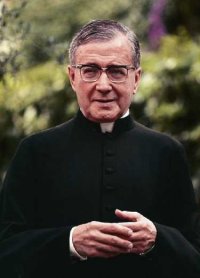
Our Lord does not disguise the fact that his wholehearted obedience to God's will calls for renunciation and self-sacrifice. Love does not claim rights, it seeks to serve. Jesus has led the way. How did he obey? "Unto death, death on a cross." You have to get out of yourself; you have to complicate your life, losing it for love of God and souls. "So you wanted to live a quiet life. But God wanted otherwise. Two wills exist: your will should be corrected to become identified with God's will: you must not bend God's will to suit yours."
It has made me very happy to see so many souls spend their lives — like you, Lord, "even unto death" — fulfilling what God was asking of them. They have dedicated all their yearnings and their professional work to the service of the Church, for the good of all men.
Let us learn to obey, let us learn to serve. There is no better leadership than wanting to give yourself freely, to be useful to others. When we feel pride swell up within us, making us think we are supermen, the time has come to say "no". Our only triumph will be the triumph of humility. In this way we will identify ourselves with Christ on the cross — not unwillingly or restlessly or sullenly, but joyfully. For the joy which comes from forgetting ourselves is the best proof of love."
-- Christ is passing by: homilies by Josemaría Escrivá by St Josemaría Escrivá
To learn more about St Josemaría Escrivá, please visit this site.
Wednesday, June 9, 2010
Love is the way to peace and harmony
"What does God desire of us today? What struggles must we endure to ensure the victory of God in our fragmented and highly secular reality, one that is gradually forgetting its God? It is not policies, or politics, or programmes or even economics that will change the world we live in. What can silently touch hearts and bring it peace but God’s love shining through our human weakness! It is the power of holiness. This little saint enables us to perceive a little way to holiness that is accessible. It is obvious that Thérèse still speaks to our world. Just look around you. Unlike a pilgrimage to a holy place, she has come to visit us. What mysterious rose might be handed to us today? Thérèse was aware of her weaknesses. St. Paul reminds us “when I am weak then I am strong.” Our saints are those who surrender to God’s merciful love. Love is the way to peace and harmony – there is no other way."
-- From a homily by Fr John Keating, OCarm, on the occasion of the visit of the relics of St. Thérèse to Aylesford Priory, England
-- From a homily by Fr John Keating, OCarm, on the occasion of the visit of the relics of St. Thérèse to Aylesford Priory, England
Sunday, November 29, 2009
Let us accomplish in our soul the interior emptiness that allows Him to communicate eternal life
“The holy time of Advent is going to begin. It is the most suitable time for interior souls, for those souls who constantly and through all things live hidden with Christ in God in the depths of themselves. During the waiting [period] of the great mystery, I like to meditate on that beautiful psalm 18 that we frequently pray during Matins and, above all, these verses: In them he has set a tent for the sun, which comes forth like a bridegroom leaving his chamber, and like a strong man runs its course with joy. Its rising is from the end of the heavens […] and there is nothing hid from its heat.
Let us accomplish in our soul that interior emptiness that allows Him to cast Himself over it and communicate to it His own eternal life. The Father has given Him for this end every power as the Gospel tells us. So… let us listen to Him in the silence of prayer. He is the Beginning that speaks within us. He tells us Himself: He who sent me is true, and I declare to the world what I have heard from Him.
Let us ask Him to make us sincere in our love, that is, to make us sacrificed souls because sacrifice is love put into action. He loved me and gave Himself for me.
This thought enthuses me; ‘The life of the priest and [that of] the Carmelite is an Advent the prepares the Incarnation in souls.’
The prophet David sings in a psalm: Fire goes before the Lord. That fire, is it not love? And our mission, does it not consist also in preparing the ways of the Lord uniting ourselves with Him who, according to the Apostle, is consuming Fire? At its touch, our soul will be transformed in a flame of love that diffuses itself through all the members of the body of Christ that is the Church. In this way, we will console the Heart of our divine Master {Teacher}, who presenting us to His Father will be able to say: I am glorified in them.”
-- Elisabeth de la Trinité: Œuvres complètes translated by ocdister
Let us accomplish in our soul that interior emptiness that allows Him to cast Himself over it and communicate to it His own eternal life. The Father has given Him for this end every power as the Gospel tells us. So… let us listen to Him in the silence of prayer. He is the Beginning that speaks within us. He tells us Himself: He who sent me is true, and I declare to the world what I have heard from Him.
Let us ask Him to make us sincere in our love, that is, to make us sacrificed souls because sacrifice is love put into action. He loved me and gave Himself for me.
This thought enthuses me; ‘The life of the priest and [that of] the Carmelite is an Advent the prepares the Incarnation in souls.’
The prophet David sings in a psalm: Fire goes before the Lord. That fire, is it not love? And our mission, does it not consist also in preparing the ways of the Lord uniting ourselves with Him who, according to the Apostle, is consuming Fire? At its touch, our soul will be transformed in a flame of love that diffuses itself through all the members of the body of Christ that is the Church. In this way, we will console the Heart of our divine Master {Teacher}, who presenting us to His Father will be able to say: I am glorified in them.”
-- Elisabeth de la Trinité: Œuvres complètes translated by ocdister
Saturday, October 17, 2009
No sacrifice can be accepted by God unless it is the result of a free and generous love of man
"The magnificent love of God has chosen creatures to be the object of His predilection, not with an exclusive love but with a love that surpasses all human loves, a paradoxical love, which intensely loves the individual simultaneously embracing all men; a love which is not simply limitless bur rather inexhaustible and ever increasing, directing all human affections back to the source from which they came, namely God. So marvelous was this love that Christ did not come to extinguish this mutual and reciprocal love found among men but rather to purify it so all men might come to love their neighbor in the heart of God. In a most solemn moment the divine Master proclaimed love the fulfilling of the law, the synthesis of all the obligations of men. 'A new commandment I give unto you: that you love one another as I have loved you.'
The entire doctrine on love, as given by St John [of the Cross], can be reduced to three points:
1. No work, no matter how well accomplished it may be, is worthy of God if it is not permeated with charity.
2. No human love is acceptable to God, if it does not accord with the love God has for each of His creatures. 'I have given you an example, that as I have done, so you do also.'
3. The perfection of love consists in the fact that we love all men equally, in God and for God, showing to each the same love which God reserves for privileged souls.
Viewing the admonitions of St John from this point we find that his teachings are in complete accord with the teachings of Christ. He asks no sacrifice other than that asked by Christ Himself. Rather he teaches that we must love our fellow man as Christ has loved us. We know well that Christ loved men infinitely and because of this love He readily sympathized with them in all their trials and sorrows ever showing them the greatest affection and love. He loved His eternal Father more, even to the extent of not hesitating to separate Himself from he love of His creatures when the glory of His Father required it. The love of Christ for His Mother was incomparable, yet He did not hesitate to sacrifice His blood for all men even though this sacrifice of His life meant the breaking of His Mother's heart. With this double sacrifice of the Son and His Mother, Divine Providence was pleased to redeem the world. From the price demanded for the Redemption we can conclude that the moral world rests on the double column of love and sacrifice. No human act can be worthy of God unless it is accompanied by sacrifice; no sacrifice can be accepted by God unless it is the result of a free and generous love of man."
-- The Secret of Sanctity of St John of the Cross by Bl Lucas of St Joseph, ocd
Friday, October 9, 2009
Love does not always heed the desires of those whom it loves
"Sensible joy, when God gives it, is indeed sweet, but it is not essential, and it would be harmful when He withdraws it. Take, then, what He gives - that is all that matters. Love does not always heed the desires of those whom it loves. It knows what is good for them and procures it for them, and satisfies their desires provided they are in accordance with that good. That is how God acts. Do not forget that God is Love. We should live with this great truth constantly before us."
-- They Speak by Silences by A Carthusian
Friday, August 21, 2009
Love causes us to go out of ourselves and live in those we love
"God is at the deep centre of all things, and when we find him there we find eternal life. Every creature gifted with reason has received light to see in all reacted things both their own individual beauty and that of the Supreme Being, from whom they have received their being, and who sustains them in it. With the light given us we should see God in all things. Our gaze should pass beyond the shadows of created things in order that it may rest in the true Light hidden in beings without reason, but discovered by those who have reason. And with this Being we should make ourselves in harmony.
-o-
All material things are a source of beauty and enrichment. It is not their fault that we do not profit by them more. The fault is ours entirely, in that we have not the courage to break the husk and seek the fruit.
-o-
It is a law of life that we are slowly transformed by those with whom we are brought into contact. Love makes like. Love causes us to go out of ourselves and live in those we love. It moves us to make their thoughts and feelings our own, to share in their lives, and so become one with them. Thus admiration invites imitation. Almost irresistibly we feel impelled to imitate all that appears to us good and beautiful; we set it up as a model that we would copy.
Religion is such a contact. It creates ties which bind God and the believer. If our god is matter, we become material; if it is something beneath us, we are lowered. Union is only possible when two beings approach and meet on a common level."
-- Where Silence is Praise by A Carthusian
Saturday, July 11, 2009
Glorify God by helping Jesus save souls
"Jesus came down among us to glorify His Father and for Him He sacrificed Himself. But He came also to save us and for us He shed His blood to its very last drop. It follows that he who thinks only of his own sanctification cannot claim that He acts in conformity with Christ's designs and imitates the life of Jesus. It is not enough to live in God's presence while remaining unconcerned about the lot of so many souls that are heading towards perdition. Realizing how little God is loved and to what extent Christ's sufferings and death are rendered useless, or at least fruitless, for many souls, how can we refuse to apply ourselves with all our heart to the task of consoling the heart of our Savior by bringing the infinite merits of Jesus Christ to our fellowmen?
If so many virtuous people fail to make progress in spiritual life, is it not often on account of their lack of charity? They show no interest in the spiritual good of others. They have no zeal for souls. A more perfect practice of charity, a greater devotedness to the salvation of souls would help them become more detached from self-love and forget their personal interests. By that means they would advance in the love of God and strengthen their union with Him."
-- Complete Spiritual Doctrine of St Thérèse of Lisieux by Fr François Jamart, ocd
Subscribe to:
Posts (Atom)


 Posts
Posts


