Showing posts with label St John Chrysostom. Show all posts

Tuesday, May 10, 2011

The Lord will accept the last even as the first


If any man be devout and love God,
let him enjoy this fair and radiant triumphal feast.

If any man be a wise servant,
let him enter rejoicing into the joy of his Lord.

If any have labored long in fasting,
let him now receive his recompense.

If any have wrought from the first hour,
let him today receive his just reward.

If any have come at the third hour,
let him with thankfulness keep the feast.

If any have arrived at the sixth hour,
let him have no misgivings,
because he shall in no wise be deprived.

If any have delayed until the ninth hour,
let him draw near, fearing nothing.

If any have tarried even until the eleventh hour,
let him also be not alarmed at his tardiness;
for the Lord, who is jealous of his honor,
will accept the last even as the first;
he gives rest unto him who comes at the eleventh hour,
even as unto him who has worked from the first hour.

And He shows mercy upon the last,
and cares for the first;
and to the one he gives, and upon the other he bestows gifts.
And he both accepts the deeds,
and welcomes the intention,
and honors the acts and praises the offering.

Wherefore, enter ye all into the joy of your Lord,
and receive your reward,
both the first and likewise the second.

You rich and poor together,
hold high festival.

You sober and you heedless,
honor the day.

Rejoice today,
both you who have fasted
and you who have disregarded the fast.

The table is fully laden;
feast sumptuously.

The calf is fatted;
let no one go hungry away.

Enjoy the feast of faith;
receive all the riches of loving-kindness.

Let no one bewail his poverty,
for the universal kingdom has been revealed.

Let no one weep for his iniquities,
for pardon has shone forth from the grave.

Let no one fear death,
for the Savior's death has set us free:
he that was held prisoner of it has annihilated it.

By descending into hell, he made hell captive.
He embittered it when it tasted of his flesh.
And Isaiah, foretelling this, cried:
"Hell was embittered when it encountered thee in the lower regions."

It was embittered, for it was abolished.
It was embittered, for it was mocked.
It was embittered, for it was slain.
It was embittered, for it was overthrown.
It was embittered, for it was fettered in chains.
It took a body, and met God face to face.
It took earth, and encountered heaven.
It took that which was seen, and fell upon the unseen.

O Death, where is your sting?
O Hell, where is your victory?

Christ is risen, and you are overthrown.
Christ is risen, and the demons are fallen.
Christ is risen, and the angels rejoice.
Christ is risen, and life reigns.
Christ is risen, and not one dead remains in the grave.
For Christ, being risen from the dead,
is become the first-fruits of those who have fallen asleep.
To him be glory and dominion unto ages of ages. Amen.

-- From an Easter Sermon by St John Chrysostom

Wednesday, April 6, 2011

Prayer is the light of the spirit

"Prayer and converse with God is a supreme good: it is partnership and union with God.  As the eyes of the body are enlightened when they see light, so our spirit when it is intent on God, is illumined by his infinite light.  I do not mean the prayer of outward observance but prayer from the heart, not confined to fixed times or periods but continuous throughout the day and night.

Our spirit should be quick to reach out toward God, not only when it is engaged in meditation; at other times also, when it is carrying out its duties, caring for the needy, performing works of charity, giving generously in the service of others, our spirit should long for God and call him to mind, so that these works may be seasoned with the salt of God's love, and so make a palatable offering tot he Lord of the universe.  Throughout the whole of our lives we may enjoy the benefit that comes from prayer if we devote a great deal of time to it.

Prayer is the light of the spirit, true knowledge of God, mediating between God and man.  The spirit, raised up to heaven by prayer, clings to God with the utmost tenderness; like a child crying tearfully for its mother, it craves the milk that God provides.  It seeks the satisfaction of its own desires, and receives gifts outweighing the whole world of nature.

Prayer stands before God as an honored ambassador.  It gives joy to the spirit, peace to the heart.  I speak of prayer, not words.  It is the longing for God, love too deep for words, a gift not given by man but by God's grace.  The apostle Paul says: We do not know how we are to pray but the Spirit himself pleads for us with inexpressible longings.

When the Lord gives this kind of prayer to a man or woman, he gives him riches that cannot be taken away, heavenly food that satisfies the spirit.  One who tastes this food is set on fire with an eternal longing for the Lord: his spirit burns as in a fire of the utmost intensity.

Practice prayer from the beginning.  Paint your house with the colors of modesty and humility.  Make it radiant with the light of justice.  Decorate it with the finest gold leaf of good deeds.  Adorn it with the walls and stones of faith and generosity.  Crown it with the pinnacle of prayer.  In this way you will make it a perfect dwelling place for the Lord.  You will be able to receive him as in a splendid palace, and through his grace you will already possess him, his image enthroned in the temple of your spirit."

-- From a homily by St John Chrysostom

Monday, September 13, 2010

Memorial of St John Chrysostom

"John of Antioch, who, on account of the golden stream of his eloquence, is called by the Greeks Chrysostomos, or, The golden-mouthed, was a lawyer and man of the world of much eminence, before he turned his great intellect and wonderful industry to the study of things sacred.  He took orders, and was ordained a priest of the Church of Antioch, and after the death of Nectarius, was forced by the Emperor Arcadius to accept, though sorely against his own will, the Archbishoprick of Constantinople.  Having received the burden of a shepherd's office, in the year 398, he set himself zealously to do his duty, struggling against the degradation of public morality and the loose lives of the nobility, and thereby drew upon himself the ill-will of many enemies, especially the Empress Eudoxia, whom he had rebuked on account of the money of the widow Callitropa, and the land of another widow.

Some bishops being assembled in a Council at Chalcedon, which Council the Saint held to be neither lawful, nor public, although he was commanded to go there, he refused.  Whereupon Eudoxia, striving earnestly against him, caused him to be sent into exile.  Soon after, however, the people of the city rose, and demanded his recall, and he was then brought back again amid great public rejoicings.  Nevertheless he ceased not to war against vice, and absolutely forbade the celebration of public games round the silver statue of Eudoxia in the square outside the Church of the Eternal Wisdom.  Upon this, a party of bishops, who were enemies to him, banded together, and obtained that he should be banished again, which was done accordingly, amid the lamentations of widows and the poor, who felt as if they were being deprived of a common father.  During this exile, it almost passeth belief how much Chrysostom suffered, and how many souls he turned to the faith which is in Christ Jesus.

At this time a Council was assembled at Rome, wherein Chrysostom's restoration to his See was decreed by Pope Innocent I, but meanwhile, he was suffering great hardships and cruelties on his journey at the hands of the soldiers who had him in charge.  As he passed through Armenia he prayed in the Church of the holy martyr Basiliscus, and the same night that blessed conqueror appeared to him in a vision and said: Brother John, tomorrow thou shalt be with me.  On the next day, therefore, he received the Sacrament of the Eucharist, and, arming himself with the sign of the Cross, resigned his soul to God, it being the 14th of September.  As soon as he was dead a furious hailstorm took place at Constantinople, and after four days the Empress died.  The Emperor Theodosius, the son of Arcadius, brought the body of John Chrysostom to Constantinople with great state, and numerously attended, and on the 27th of January, laid it with magnificent honours in the grave, beside which he prayed for the forgiveness of his own father and mother.  The holy body was afterwards taken to Rome, and is now buried in the Vatican Basilica.  The number, devoutness, and brilliance of St. John Chrysostom's sermons and other writings, his acuteness in exposition, and the close aptness of his explanations of Holy Scripture, have been and are the object of universal wonder and admiration, and often seem not unworthy to have been dictated to him by the Apostle Paul, for whom he entertained a wonderful devotion.  This most outstanding Doctor of the Church universal was proclaimed and appointed the heavenly patron of sacred orators by the Supreme Pontiff, Pius X."

-- From the 1911 Breviary of St Pius X (1955 ed)

** Our brethren following the traditional calendar observed this feast on 27 January.

Friday, July 2, 2010

The Visitation of the Blessed Virgin Mary


"As soon as our Redeemer was come among us, he went with haste, while as yet he was in his mother's womb, to visit his friend John.  And John, in the one womb, as if conscious of the presence of Jesus in the other womb, dashed himself impatiently against the narrow walls of his natural prison, as though crying out: I perceive the very Lord that gave nature her bounds!  Why therefore should I wait for the due season of my birth?  What need is there for me to linger here till nine months are ended, now that the Timeless One is with me!  I would break out of my dark cell!  I would proclaim my manifold knowledge of marvellous things!  I am meant to be a sign, and so even now I would shew that the Christ is here!  I am the trumpet-voice, and I desire to peal forth the news that the Son of God is come in the flesh. Let me sound as a trumpet, and bless and loose my father's tongue, and make it speak again!  Let me sound as a trumpet and quicken my mother's womb!

Thou seest, O brethren beloved, how new and how strange a mystery is here!  John is not yet born, but by leaping he speaketh.  He is as yet unseen, but he giveth warning.  He is not yet able to cry, but by his acts he beareth witness.  He draweth not yet the breath of life, but he preacheth God.  He seeth not yet the light, but he maketh known the Sun.  He is not yet come out of the womb, but he hasteth to play the Forerunner.  In the presence of the Lord he cannot restrain himself, but rebelleth against the bounds set by nature, and struggleth to break out of the prisoning womb, eager to herald the coming Saviour.  He saith, as it were: Behold, the Deliverer cometh, and why am I yet in bonds, and made to abide here?  The Word cometh, that he may set right all things, and am I still to tarry in prison?  I would go forth!  I would run before him, and proclaim to all mankind: Behold the Lamb of God that taketh away the sin of the world.

But do thou tell us, O John, how it came to pass that while thou wast still in the darkness of thy mother's womb, thou didst see and hear?  How didst thou behold the things of God?  How didst thou leap and bound for joy?  If we could hear him answer, he would say: Great is the mystery of that which here taketh place.  Beyond the understanding of men are these doings!  It is meet that I should shew forth a new thing in nature for the sake of him who is making new things which are beyond nature.  Even though I be yet in the womb, I perceive, for forth upon me from another womb the Sun of Righteousness shineth.  As it were, with mine ears I understand, for I was created to be the Voice of the Great Word.  I would cry aloud, for I contemplate the only-begotten Son of the Father clothed in flesh.  I tremble for joy, for I perceive that he, by whom all things were made, hath taken upon him the form of a servant.  I leap as I think of the Redeemer of the world being made flesh, for I would run before his coming.  Nonetheless, I herald his approach unto you as best I can, and make on this wise my confession of him whose Forerunner I am."

-- From a sermon by St John Chrysostom

** Painting by Juan Correa del Vivar

Tuesday, January 26, 2010

Memorial of Sts Timothy and Titus


"Saints Timothy and Titus were disciples and assistants of the apostle Paul. Timothy had charge of the Church at Ephesus and Titus of the Church in Crete. The letters were written to them are called the pastoral epistles, for the contain excellent admonitions for the instruction of both pastors and laity."


-- From the Liturgy of the Hours
** The icon to the left is St Titus, the one to the right St Timothy
** Our brethren following the 1962 Liturgical calendar observe St Timothy on 24 January and St Titus on 6 February


-o-


"Though housed in a narrow prison, Paul dwelt in heaven. He accepted beatings and wounds more readily than others reach out for rewards. Sufferings he loved as much as prizes; indeed he regarded them as his prizes, and therefore called them a grace or gift. Reflect on what this means.To depart and be with Christ was certainly a reward, while remaining in the flesh meant struggle. Yet such was his longing for Christ that he wanted to defer his reward and remain amid the fight; those were his priorities.
   Now, to be separated from the company of Christ meant struggle and pain for Paul; in fact, it was a greater affliction than any struggle or pain would be. On the other hand, to be with Christ was a matchless reward. Yet, for the sake of Christ, Paul chose the separation.
   But, you may say: "Because of Christ, Paul found all this pleasant." I cannot deny that, for he derived intense pleasure from what saddens us. I need not think only of perils and hardships. It was true even of the intense sorrow that made him cry out:
Who is weak that I do not share the weakness? Who is scandalized that I am not consumed with indignation?
   I urge you not simply to admire but also to imitate this splendid example of virtue, for, if we do, we can share his crown as well.
   Are you surprised at my saying that if you have Paul's merits, you will share that same reward? Then listen to Paul himself: 
I have fought the good fight, I have run the race, I have kept the faith. Henceforth a crown of justice awaits me, and the Lord, who is a just judge, will give it to me on that day - and not to me alone, but to those who desire his coming. You see how he calls all to share the same glory?
     Now, since the same crown of glory is offered to all, let us eagerly strive to become worthy of these promised blessings.
   In thinking of Paul we should not consider only his noble and lofty virtues or the strong and ready will that disposed him for such great graces. We should also realize that he shares our nature in every respect. If we do, then even what is very difficult will seem to us easy and light; we shall work hard during the short time we have on earth and someday we shall wear the incorruptible, immortal crown. This we shall do by the grace and mercy of our Lord Jesus Christ, to whom all glory, and
power belongs  now and always through endless ages. Amen."


-- From a homily by St John Chrysostom

Monday, January 25, 2010

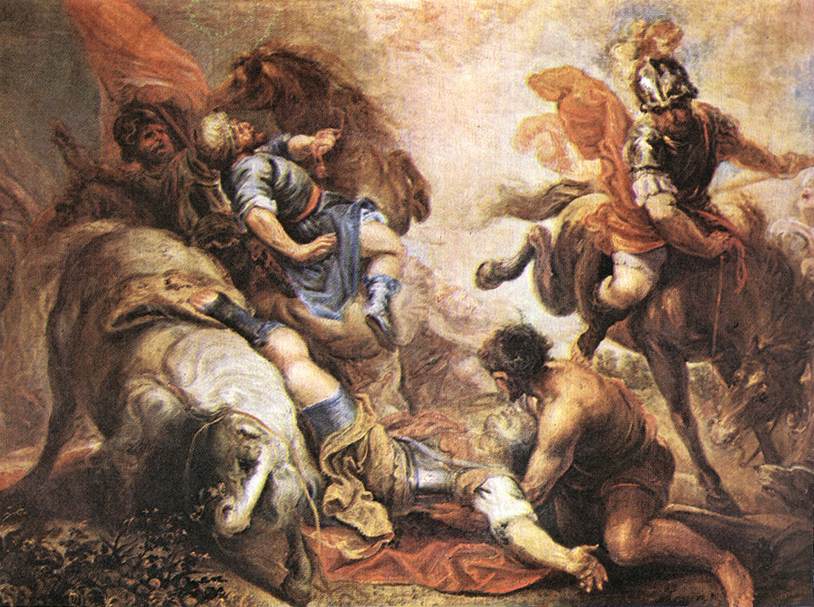
Feast of the Conversion of St Paul


"Paul, more than anyone else, has shown us what man really is, and in what our nobility consists, and of what virtue this particular animal is capable. Each day he aimed ever higher; each day he rose up with greater ardor and faced with new eagerness the dangers that threatened him. He summed up his attitude in the words: I forget what is behind me and push on to what lies ahead. When he saw death imminent, he bade others share his joy: Rejoice and be glad with me! And when danger, injustice and abuse threatened, he said: I am content with weakness, mistreatment and persecution. These he called the weapons of righteousness, thus telling us that he derived immense profit from them.
     Thus, amid the traps set for him by his enemies, with exultant heart he turned their every attack into a victory for himself; constantly beaten, abused and cursed, he boasted of it as though he were celebrating a triumphal procession and taking trophies home, and offered thanks to God for it all: 
Thanks be to God who is always victorious in us! This is why he was far more eager for the shameful abuse that his zeal in preaching brought upon him than we are for the most pleasing honors, more eager for death than we are for the most pleasing honors, more eager for death than we are for life, for poverty than we are for wealth; he yearned for toil far more than others yearn for rest after toil. The one thing he feared, indeed dreaded, was to offend God; nothing else could sway him. Therefore, the only thing he really wanted was always to please God.
     The most important thing of all to him, however, was that he knew himself to be loved by Christ. Enjoying this love, he considered himself happier than anyone else; were he without it, it would be no satisfaction to be the friend of principalities and powers. He preferred to be thus loved and be the least of all, or even to be among the damned, than to be without that love and be among the great and honored.
     To be separated from that love was, in his eyes, the greatest and most extraordinary of torments; the pain of that loss would alone have been hell, and endless, unbearable torture.
     So too, in being loved by Christ he thought of himself as possessing life, the world, the angels, present and future, the kingdom, the promise and countless blessings. Apart from that love nothing saddened or delighted him; for nothing earthly did he regard as bitter or sweet.
     Paul set no store by the things that fill our visible world, any more than a man sets value on the withered grass of the field. As for tyrannical rulers or the people enraged against him, he paid them no more heed than gnats.
     Death itself and pain and whatever torments might come were but child's play to him, provided that thereby he might bear some burden for the sake of Christ."


-- From a homily by St John Chrysostom


* Painting by Juan Antonio Frias y Escalante