
Showing posts with label Albert of Trapani. Show all posts

Saturday, August 7, 2010

Memorial of St Albert of Trapani

"Albert was born (after twenty-six years of sterile marriage) of Benedict degli Abati and Joan Palizi, both of whom promised to consecrate him to the Lord. While the boy was still of a tender age, his father thought of arranging an honorable marriage for him; but his mother was able to make her husband keep their vow. After Albert had joined the Carmelites of Trapani, he spent his period of formation growing in virtue and was ordained a priest. His superiors sent him to Messina, which he freed from the famine caused by a siege: some ships loaded with provisions miraculously passed through the besiegers.

Albert was a famous preacher in various places on the island, and for a certain time provincial superior of the Carmelites of Sicily. He died at Messina on Aug. 7 in an undetermined year, probably in 1307 (as J. B. Lezana, O. Carm., with others, suggests). Heaven itself, it is narrated, wished to decide the controversy that arose between the clergy and the people about the kind of Mass to be celebrated on that occasion: two angels appeared and intoned the Os justi /The mouth of the just man/, the introit of the Mass of Confessors.

The presence of Albert in the convent of Trapani on Aug. 8, 1280, April 4 and Oct. 8, 1289, is attested by several parchments of the same convent, now in the Fardelliana library of the same city. Here is also found a parchment in the date of May 10, 1296 from which his office as provincial superior is ascertained.

The date of a translation of his relics, said to have been made in the year 1309 or 1316, is uncertain. (This latter would seem more exact, if it is true that the provincial, who is said to have supervised the translation, died soon after, on his way to France to a general chapter — that held, in fact, at Bordeaux in l318.) Albert was among the first Carmelite saints venerated by the Order, of which he was later considered a patron and protector. Already in 1346 there was a chapel dedicated to him, in the convent of Palermo. At various general chapters, beginning with that of 1375, his papal canonisation was proposed In the chapter of 1411 it was said that his proper office was ready.

In 1457 Pope Callixtus III, by verbal consent (vivae vocis oracido); permitted his cult, which was consequently confirmed by Sixtus IV with a bull of May 31, 1476. In 1524 it was ordered that his image be found on the seal of the general chapter; moreover, the general of the Order, Nicholas Audet, wanted an altar dedicated to him in every Carmelite church. Even earlier, the chapter of 1420 had ordered that his image with a halo should be found in all the convents of the Order.

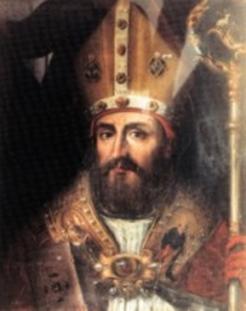
With this intense and extended cult, his abundant iconography is easily understood. In it he is represented (with or without a book), first, bearing a lily, a symbol of his victory over the senses at the beginning of his religious life; then, in the act of overcoming the devil, or also, from the XVII cent on, while he is working his miracles.

In 1623 one of the gates of the city of Messina was dedicated to him. He is the patron of Trapani, of Erice, of Palermo and of Revere (Mantua). St Teresa of Jesus and St Mary Magdalen de'Pazzi were especially devoted to him; the Bl. Baptist Spagnoli composed a sapphic ode in his honor. His relics are spread throughout Europe. They are necessary for the blessing of St Albert's water, much used, especially in the past, against fevers. The head of the Saint is in the Carmelite church of Trapani.

St Albert appears frequently in the legends and popular traditions of Sicily. Agrigento vaunted a well, the water of which Albert had purified; Corleone, the receptacle in which he preserved absinthe; Petralia Soprana, a stone on which he rested. The first chapel erected to him was claimed to have been at Piazza Armerina.

In the last liturgical reform the rank of feast was granted for St. Albert to the Carmelites, and of memorial to the Discalced of the same Order."

-- Biography by Fr Louis Saggi, OCarm

Friday, August 7, 2009

Memorial of St Albert of Trapani

"A tradition confirmed by various documents says that Albert was born in Trapani around the middle of the thirteenth century. His parents were Benedetto degli Abati and Giovanna Polizi, a couple who had been unable to have children in twenty-six years of marriage. This detail recalls the great biblical examples of Samuel (1 Sm 1:1-2, 11) and John the Baptist (Lk 1:5-25, 5 7-80). The mother initiated his vocation by promising him to the Lord and she sustained this commitment even in the face of the plans of Albert’s father, who wanted to see him married and inheriting the family fortune. Albert joined the Carmelites who had established a priory in Trapani and whose foundation had been endowed by his family. After ordination Albert was sent to Messina. Various documents testify the he had returned to Trapani not later than August 1280, when he witnessed the will of Ribaldo Abati. He was in the city again on April 4, 1289, when he witnessed the will of Perna, the second wife of the same Ribaldo, and again on October 8th the same year, when he witnessed a contract relating to property of the knight, Palmerio Abati. Albert was remembered as a man of prayer and as a celebrated preacher sought after throughout Sicily. A document of 10 May 1296, recording a gift by Palmerio Abati to Donna Perna, mentions that Albert is Carmelite Provincial of Sicily.

There is no record of Albert’s participation in the crucial events in the history of the Order in those times, nor of how he may have contributed to the consolidation and growth of the Order, but there is no doubt that as a friar who had a deep experience of God and a real capacity to recognize people’s needs, his work in preaching and charity contributed much to the growing appreciation of the Order in Sicily. It is perhaps not only by reason of antiquity that the title pater ordinis came to be conferred on him.

Tradition is that Albert died in Messina on August 7th 1307. The tradition also records the episode of an argument between the clergy and the laity at the time of his funeral. Popular affection and devotion led to the people to want to celebrate Albert as a saint, but the clergy preferred a normal Requiem Mass. The legend recounts that, in the middle of the argument, some angels appeared and intoned the Os justi, the Introit for the Mass of a Confessor, and thus confirmed the popular feeling and Albert’s reputation for holiness.

The translation of his relics took place either in 1309 or more probably, in 1317. The skull was taken from Messina to Trapani by the provincial Cataldo di Anselmo of Erice. Other relics of Albert were dispersed to various places. All through Sicily there are memories of the presence of Albert and of miracles he performed. In Agrigento there is a well whose water he purified; at Corleone his flask for wormwood was preserved; at Petralia Soprana there is a stone which he used as a pillow; at Piazza Armerina there is said to be the first chapel in his honour.

Many miracles were attributed to the saint, both in his lifetime and after his death. While he was in Messina he managed to lift the blockade imposed on the city in 1301 by Robert of Calabria, then King of Naples. Through Albert’s intercession one or more ships—the sources mention from one to twelve—succeeded in breaking the siege and bringing provisions to the starving people of Messina.

St. Albert appeared as a true disciple of the Lord, an authentic witness of his incarnation, passion, death and resurrection. In fact, he spent the greater part of his time and energy as a preacher. His preaching was confirmed by the wonders it accomplished: he not only proclaimed the Gospel, but healed the sick, gave sight to the blind, and drove out demons according to the commission Jesus gave to the disciples (Mk 16:9-20). The Word he preached was materialized in gestures of tender attention to those who were in real need of healing and new life. His arrival in a place really brought good news, the Gospel. His life, simple and coherent, spoke on its own, spoke of Christ and his gift of salvation and grace. This transparency of his life allowed him to translate the Word into concrete actions, and this also expressed in a certain way his devotion to the Blessed Virgin: like Mary he knew how to give life to the Word, he was a “God machine,” as his confrère Blessed Titus Brandsma would have said some centuries later."

-- Albert of Trapani: A Saint of Yesterday for Today by Fr Giovanni Grosso, OCarm