Showing posts with label St Sylvester I. Show all posts

Friday, December 31, 2010

Memorial of St Sylvester

"Sylvester was a Roman by birth, and his father's name was Rufinus.  He was brought up from a very early age under a Priest named Cyrinus, of whose teaching and example he was a diligent learner.  During the fury of the persecutions, Sylvester hid himself upon Mount Soracte.  In his thirtieth year he was ordained Priest of the Holy Roman Church by Pope Marcellinus.  In the discharge of his duties he became a model for all the clergy, and, after the death of Melchiades, he succeeded him on the Papal throne, during the reign of Constantine, who had already by public decree proclaimed peace to the Church of Christ.  Hardly had he undertaken the government of the Church when he betook himself to stir up the Emperor to protect and propagate the religion of Christ.  Constantine was fresh from his victory over his enemy Maxentius, on the Eve whereof the sign of the Cross had been revealed to him limned in light upon the sky; and there was an old story in the Church of Rome that it was Sylvester who caused him to recognise the images of the Apostles, administered to him holy Baptism, and cleansed him from the leprosy of misbelief.


The godly Emperor had already granted to Christ's faithful people permission to build public churches, and by the advice of Sylvester he himself set them the example.  He built many Basilicas, and magnificently adorned them with holy images, and gifted them with gifts and endowments.  Among these there were, besides others, the Church of Christ the Saviour, hard by the Lateran Palace; that of St. Peter, upon the Vatican Mount; that of St. Paul, upon the Ostian Way; that of St. Lawrence in Agro Verano; that of the Holy Cross in Atro Sessoriano; that of St. Peter and St. Marcellinus, upon the Labican Way; and that of St. Agnes, upon the Nomentan Way.  Under this Pope was held the first Council of Nice, presided over by the Papal Legates, and in the Presence of Constantine, and three hundred and eighteen Bishops, where the holy and Catholick Faith was declared, and Arius and his followers condemned; which Council was finally confirmed by the Pope, at the request of all the assembled Fathers, in a synod held at Rome, where Arius was again condemned.  This Pope issued many useful ordinances for the Church of God.  He reserved to Bishops the right of consecrating the Holy Chrism; ordered Priests to anoint with Chrism the heads of the newly baptized; settled the offíciating dress of Deacons as a dalmatic and linen maniple; and forbade the consecration of the Sacrament of the Altar on anything but a linen corporal.


This Sylvester is likewise said to have ordained that all persons taking Holy Orders should remain a while in each grade  before being promoted to a higher; that laymen should not go to law against the clergy; and that the clergy themselves were not to plead before civil tribunals.  He decreed that the first and seventh days of the week should be called respectively the Lord's Day and the Sabbath, and the others, Second Day, Third Day, and so on.  In this he confirmed the use of the word Feria for the weekdays, the which use had already begun in the Church.  This word signifieth an holiday, and pointeth to the duty of the clergy ever to lay aside all worldly labour, and leave themselves free to do continually the work of the Lord.  The heavenly wisdom with which he ruled the Church of God, was joined in him to a singular holiness of life, and an inexhaustible tenderness towards the poor; in which matter he ordained that the wealthy clergy should each relieve a certain number of needy persons; and he also made arrangements for supplying the consecrated virgins with the necessaries of life.  He lived as Pope twenty-one years, ten months and one day, and was buried in the cemetery of Priscilla on the Salarian Way.  He held seven ordinations in the month of December, and made forty-two priests, twenty-five deacons, and sixty-five bishops of various sees."


-- From the 1911 Breviary of St Pius X (1955 ed)

Thursday, December 31, 2009

Commemoration of St Sylvester I


"Sylvester was a Roman by birth, and his father's name was Rufinus.  During the fury of the persecutions, he hid himself upon Mount Soracte.  In his thirtieth year he was ordained Priest of the Holy Roman Church.  After the death of Melchiades, he succeeded him on the Papal throne, during the reign of Constantine, who had already by public decree proclaimed peace to the Church of Christ.  Sylvester betook himself so to stir up the Emperor to protect and propagate the religion of Christ that Constantine built many Basilicas, and magnificently adorned them.  Under this Pope was held the first Council of Nice, at which Arius was condemned ; which Council was finally confirmed by Sylvester.  After a life of holiness and tenderness towards the poor, he died in peace and was buried in the cemetery of Priscilla."


-- Biography from the 1911 Breviary (known as the St Pius X Breviary)
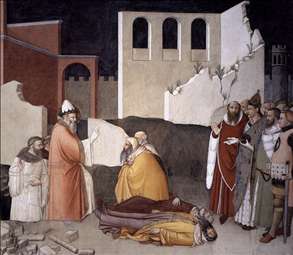
* Painting by Maso di Banco
-o-


"God’s Son did not disdain to become a baby. Although with the passing of the years he moved from infancy to maturity, and although with the triumph of his passion and resurrection all the actions of humility which he undertook for us were finished, still today’s festival renews for us the holy childhood of Jesus born of the Virgin Mary. In adoring the birth of our Saviour, we find we are celebrating the commencement of our own life, for the birth of Christ is the source of life for Christian folk, and the birthday of the Head is the birthday of the body.
  Every individual that is called has his own place, and all the sons of the Church are separated from one another by intervals of time. Nevertheless, just as the entire body of the faithful is born in the font of baptism, crucified with Christ in his passion, raised again in his resurrection, and placed at the Father’s right hand in his ascension, so with Him are they born in this nativity.
  For this is true of any believer in whatever part of the world, that once he is reborn in Christ he abandons the old paths of his original nature and passes into a new man by being reborn. He is no longer counted as part of his earthly father’s stock but among the seed of the Saviour, who became the Son of man in order that we might have the power to be the sons of God.
  For unless He came down to us in this humiliation, no one could reach his presence by any merits of his own.
  The very greatness of the gift conferred demands of us reverence worthy of its splendour. For, as the blessed Apostle teaches, We have received not the spirit of this world but the Spirit which is of God, that we may know the things which are given us by God. That Spirit can in no other way be rightly worshipped, except by offering him that which we received from him.
  But in the treasures of the Lord’s bounty what can we find so suitable to the honour of the present feast as the peace which at the Lord’s nativity was first proclaimed by the angel-choir?
  For it is that peace which brings forth the sons of God. That peace is the nurse of love and the mother of unity, the rest of the blessed and our eternal home. That peace has the special task of joining to God those whom it removes from the world.
  So those who are born not of blood nor of the will of the flesh nor of the will of man but of God must offer to the Father the unanimity of peace-loving sons, and all of them, adopted parts of the mystical Body of Christ, must meet in the First-begotten of the new creation. He came to do not his own will but the will of the one who sent him; and so too the Father in his gracious favour has adopted as his heirs not those that are discordant nor those that are unlike him, but those that are one with him in feeling and in affection. Those who are re-modelled after one pattern must have a spirit like the model.
  The birthday of the Lord is the birthday of peace: for thus says the Apostle, He is our peace, who made both one;because whether we are Jew or Gentile, through Him we have access in one Spirit to the Father." 


-- From a sermon by Pope St Leo the Great