



"If you know what witness means, you understand why God brings St. Stephen, St. John, and the Holy Innocents to the crib in the cave as soon as Christ is born liturgically. To be a witness is to be a martyr. Holy Mother Church wishes us to realize that we were born in baptism to become Christ — He who was the world's outstanding Martyr."
-- Love Does Such Things by Rev. M. Raymond, O.C.S.O.
Showing posts with label St Stephen. Show all posts
Showing posts with label St Stephen. Show all posts
Monday, December 26, 2011


Sunday, December 26, 2010
Memorial of St Stephen, Protomartyr
We have already remarked that the words: Fill ye up then the measure of your fathers: may have reference to the Lord as the one whom the Jews were afterward to put to death. In a secondary sense it may likewise be applied to his disciples, of whom he speaketh when he saith: Behold, I send unto you prophets, and wise men, and scribes. Here observe that, as the Apostle wrote to the Corinthians, there are diversities of gifts amongst Christ's followers. Some are prophets of that which is to come; some are wise men who know the due season for rebuke, and exhortation; some are scribes learned in the Law. And of these Stephen was stoned, Paul was slain with the sword, Peter was crucified, and the disciples of whom mention is made in the Acts of the Apostles were scourged.
It is a subject of dispute amongst commentators as to what is meant by Zacharias the son of Barachias, for we read of several persons of this name. But in this passage, as if to prevent any mistake, is added: Whom ye slew between the temple and the altar. I have read various opinions in various places upon this question, and I will give you each. First, some hold that this Zacharias was the eleventh of the twelve Minor Prophets, which same is called the son of Barachias. But the Bible nowhere telleth us that this Prophet was slain between the temple and the altar; and it is hardly possible in his day that even the ruins of the temple were in existence. Secondly, others maintain that this Zacharias was the father of John the Baptist. Such an interpretation is derived from certain vain imaginations of the apocryphal Gospels, wherein it is asserted that he was martyred for preaching the Saviour's coming.
A third school will have it that this Zacharias, the son of Barachias, was that Zacharias of whom we read in the second Book of Chronicles, that he was slain by Joash, King of Judah, in the court of the house of the Lord, which same might be understood as between the temple and the altar. However, that Zacharias was not the son of Barachias, but of Jehoiada the priest, whence it is written: Joash the King remembered not the kindness which Jehoiada his father had done to him, but slew his son. The question therefore ariseth, if this opinion be true, why the manner of death agreeth with this explanation but the name doth not, since Zacharias is called the son of Jehoiada rather than of Barachias. The Hebrew word Barachias signifieth Blessed-of-the-Lord, and this might be an honourific title for Jehoiada, used to imply his righteousness, inasmuch as our Lord was making reference to the shedding of righteous blood. Further, we might find that in the Gospel used by the Nazarenes the name of Jehoiada is used instead of Barachias."
-- From a homily by St Jerome
It is a subject of dispute amongst commentators as to what is meant by Zacharias the son of Barachias, for we read of several persons of this name. But in this passage, as if to prevent any mistake, is added: Whom ye slew between the temple and the altar. I have read various opinions in various places upon this question, and I will give you each. First, some hold that this Zacharias was the eleventh of the twelve Minor Prophets, which same is called the son of Barachias. But the Bible nowhere telleth us that this Prophet was slain between the temple and the altar; and it is hardly possible in his day that even the ruins of the temple were in existence. Secondly, others maintain that this Zacharias was the father of John the Baptist. Such an interpretation is derived from certain vain imaginations of the apocryphal Gospels, wherein it is asserted that he was martyred for preaching the Saviour's coming.
A third school will have it that this Zacharias, the son of Barachias, was that Zacharias of whom we read in the second Book of Chronicles, that he was slain by Joash, King of Judah, in the court of the house of the Lord, which same might be understood as between the temple and the altar. However, that Zacharias was not the son of Barachias, but of Jehoiada the priest, whence it is written: Joash the King remembered not the kindness which Jehoiada his father had done to him, but slew his son. The question therefore ariseth, if this opinion be true, why the manner of death agreeth with this explanation but the name doth not, since Zacharias is called the son of Jehoiada rather than of Barachias. The Hebrew word Barachias signifieth Blessed-of-the-Lord, and this might be an honourific title for Jehoiada, used to imply his righteousness, inasmuch as our Lord was making reference to the shedding of righteous blood. Further, we might find that in the Gospel used by the Nazarenes the name of Jehoiada is used instead of Barachias."
-- From a homily by St Jerome
Saturday, December 26, 2009
Feast of St Stephen Martyr
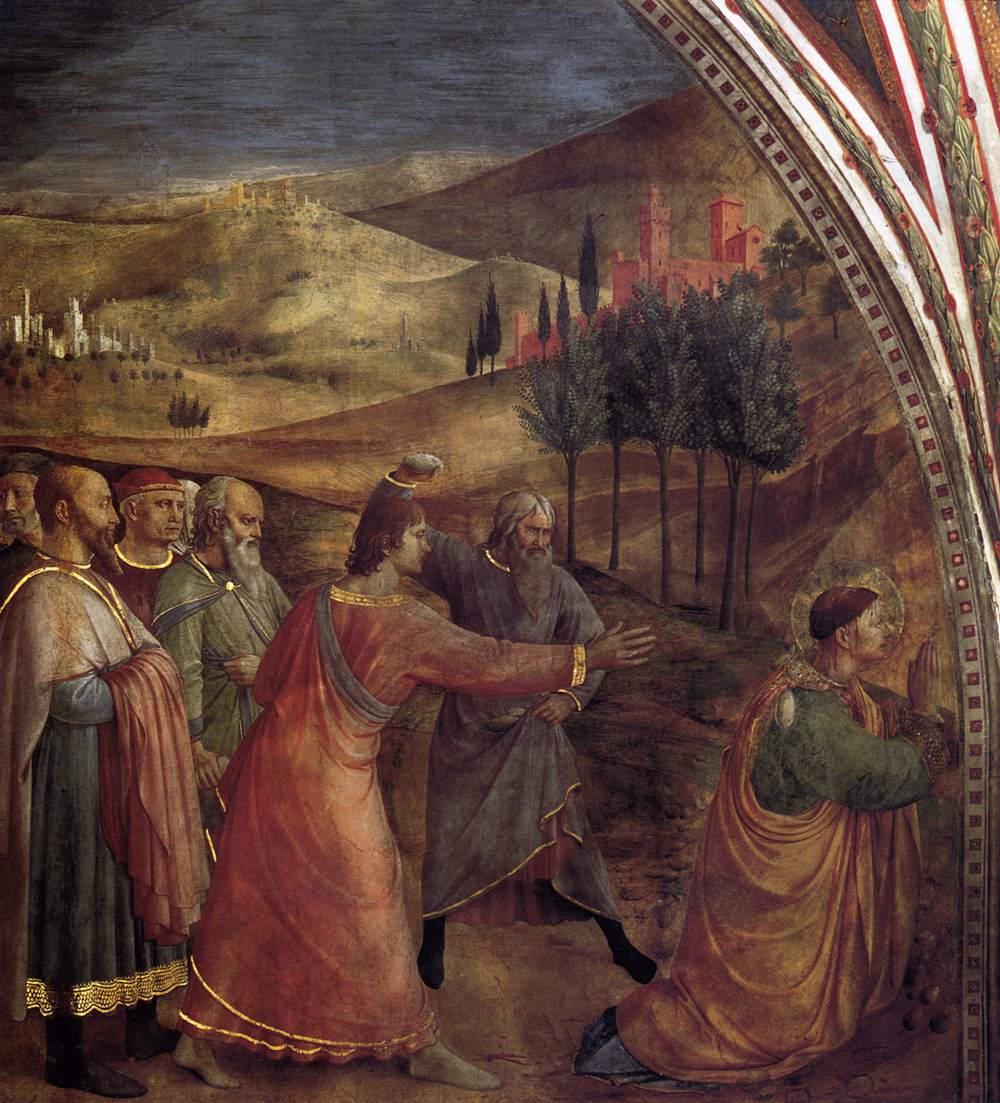
Our King, despite his exalted majesty, came in humility for our sake; yet he did not come empty-handed. He brought his soldiers a great gift that not only enriched them but also made them unconquerable in battle, for it was the gift of love, which was to bring men to share in his divinity. He gave of his bounty, yet without any loss to himself. In a marvelous way he changed into wealth the poverty of his faithful followers while remaining in full possession of his own inexhaustible riches.
And so the love that brought Christ from heaven to earth raised Stephen from earth to heaven; shown first in the king, it later shone forth in his soldier. Love was Stephen's weapon by which he gained every battle, and so won the crown signified by his name. His love of God kept him from yielding to the ferocious mob; his love for his neighbor made him pray for those who were stoning him. Love inspired him to reprove those who erred, to make them amend; love led him to pray for those who stoned him, to save them from punishment. Strengthened by the power of his love, he overcame the raging cruelty of Saul and won his persecutor on earth as his companion in heaven. In his holy and tireless love he longed to gain by prayer those whom he could not convert by admonition.
Now at last, Paul rejoices with Stephen, with Stephen he delights in the glory of Christ, with Stephen he exults, with Stephen he reigns. Stephen went first, slain by the stones thrown by Paul, but Paul followed after, helped by the prayer of Stephen. This, surely, is the true life, my brothers, a life in which Paul feels no shame because of Stephens death, and Stephen delights in Paul's companionship, for love fills them both with joy. It was Stephen's love that prevailed over the cruelty of the mob, and it was Paul's love that covered the multitude of his sins; it was love that won for both of them the kingdom of heaven.
Love, indeed, is the source of all good things; it is an impregnable defense, and the way that leads to heaven. He who walks in love can neither go astray nor be afraid: love guides him, protects him, and brings him to his journey's end.
My brothers, Christ made love the stairway that would enable all Christians to climb to heaven. Hold fasts to it, therefore, in all sincerity, give one another practical proof of it, and by your progress in it, make your ascent together."
--From a sermon by Saint Fulgentius of Ruspe
** Painting by Fra Angelico
Subscribe to:
Posts (Atom)


 Posts
Posts


