
"From the tenth century onwards veneration for St. Catherine of Alexandria has been widespread in the Church of the East, and from the time of the Crusades this saint has been popular in the West, where many churches have been dedicated to her and her feast day kept with great solemnity, sometimes as a holy-day of obligation. She is listed as one of the Fourteen Holy Helpers of mankind among the saints in Heaven; she is the patroness of young women, philosophers, preachers, theologians, wheelwrights, millers, and other workingmen. She was said to have appeared with Our Lady to St. Dominic and to Blessed Reginald of Orleans; the Dominicans adopted her as their special protectress. Hers was one of the heavenly voices heard by St. Joan of Arc.
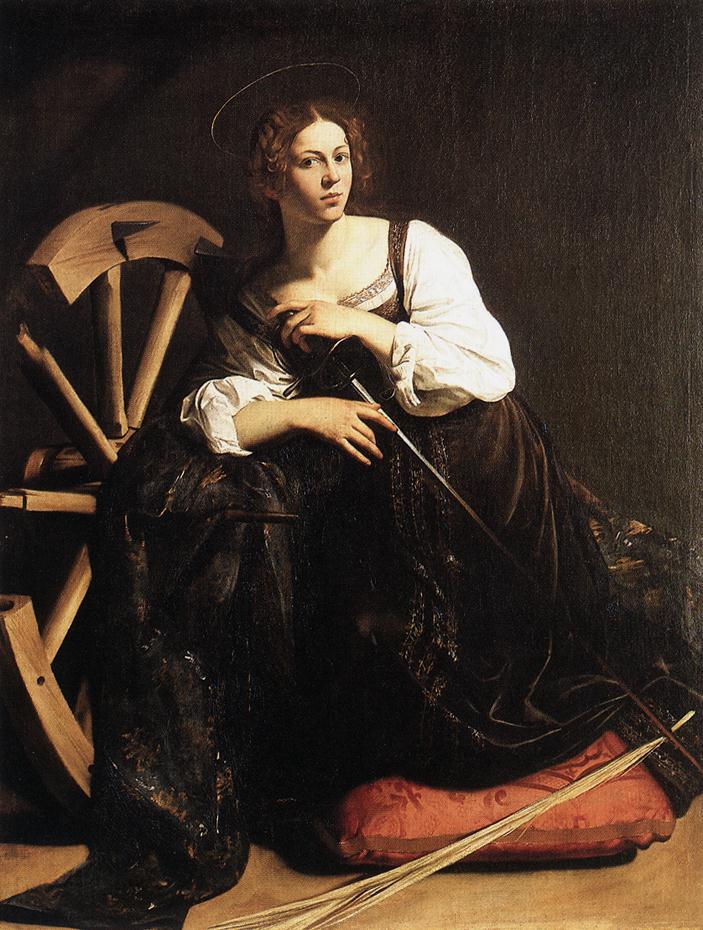
Artists have painted her with her chief emblem, the wheel, on which by tradition she was tortured; other emblems are a lamb and a sword. Her name continues to be cherished today by the young unmarried women of Paris.
Yet in spite of this veneration, we have few facts that can be relied on concerning Catherine's life. Eusebius, "father of Church history," writing around the year 320, had heard of a noble young Christian woman of Alexandria whom the Emperor ordered to come to his palace, presumably to become his mistress, and who, on refusing, was punished by banishment and the confiscation of her estates. The story of St. Catherine may have sprung from some brief record such as this, which Christians writing at a later date expanded. The last persecutions of Christians, though short, were severe, and those living in the peace which followed seem to have had a tendency to embellish the traditions of their martyrs that they might not be forgotten.
According to the popular tradition, Catherine was born of a patrician family of Alexandria and from childhood had devoted herself to study. Through her reading she had learned much of Christianity and had been converted by a vision of Our Lady and the Holy Child. When Maxentius began his persecution, Catherine, then a beautiful young girl, went to him and rebuked him boldly for his cruelty. He could not answer her arguments against his pagan gods, and summoned fifty philosophers to confute her. They all confessed themselves won over by her reasoning, and were thereupon burned to death by the enraged Emperor. He then tried to seduce Catherine with an offer of a consort's crown, and when she indignantly refused him, he had her beaten and imprisoned. The Emperor went off to inspect his military forces, and when he got back he discovered that his wife Faustina and a high official, one Porphyrius, had been visiting Catherine and had been converted, along with the soldiers of the guard. They too were put to death, and Catherine was sentenced to be killed on a spiked wheel.
When she was fastened to the wheel, her bonds were miraculously loosed and the wheel itself broke, its spikes flying off and killing some of the onlookers. She was then beheaded. The modern Catherine-wheel, from which sparks fly off in all directions, took its name from the saint's wheel of martyrdom. The text of the
of this illustrious saint states that her body was carried by angels to Mount Sinai, where a church and monastery were afterwards built in her honor. This legend was, however, unknown to the earliest pilgrims to the mountain. In 527 the Emperor Justinian built a fortified monastery for hermits in that region, and two or three centuries later the story of St. Catherine and the angels began to be circulated."
-- Lives of Saints by John J. Crawley & Co., Inc.
St Catherine of Alexandria is patron saint of young women, millers, philosophers, preachers, spinners, students and wheelwrights. This painting depicting St Catherine is by Caravaggio.







 Posts
Posts


