
Sunday, November 6, 2011

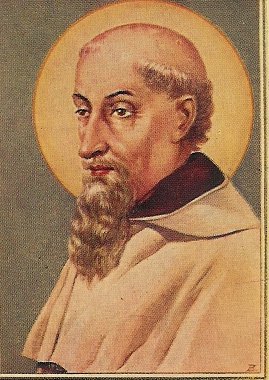
Memorial of St Nuño of St Mary (Alvares Pereira)


"Nuno was born at Sernache do Bomjardim (Portugal) on June 24, son of the noble, Don Alvaro Gonçalves Pereira, grand prior of the priory of Crato, of the Order of the Knights of St. John of Jerusalem. Nuno grew up in the company of the knights dependent on his father and was given to the reading of the knightly and military deeds of the Round Table. At the age of thirteen he was admitted to the court of King Ferdinand, in view of a military career. He soon gave such proofs of bravery that while still thirteen years old he was chosen as an equerry of the queen and created a knight. In imitation of Galahad, the pure knight of the Holy Grail, he would have wished to remain celibate; but, so as not to oppose his father, on Aug. 15, 1376, he consented to take Lady Eleonora de Alvim as his wife. He had three children, two of whom died young; the third, Beatrice, in 1401 married Don Alphonse, a son of King John I. Don Alphonse was also Count of Barcelos and the first Duke of Braganza, the founder of several princely and royal dynasties of Europe.

During the war between Portugal and Castile Nuno had many occasions to show his valor, which, however, was fully revealed only in the political crisis that followed the death of King Ferdinand (Oct. 22, 1383). Among the supporters of the right of Beatrice to the throne of Portugal—she was the daughter of the deceased King Ferdinand and the wife of the King of Castile—were not a few Portuguese, among them Nuno's own brothers. Nuno, however, tenaciously opposed the incorporation of Portugal into the kingdom of Castile and, in order to safeguard national independence, defended the candidacy of John, Master of Aviz, a brother of King Ferdinand; at the same time Nuno endeavored to overcome the hesitations and opposition of his compatriots. On April 6, 1384, he overcame the followers of the King of Castile in the battle of Atoleiros. A year later the Master of Aviz was proclaimed king of Portugal, and he chose Nuno as his Constable. Thus, at only twenty-five years of age, Nuno became the supreme commander of the army. On Aug. 14, 1385, he engaged in the battle of Aljubarrota and the definitive defeat of the Castilians, despite the fact that the Portuguese were greatly outnumbered. Nuno then passed to the offensive and gained another glorious victory in Castilian territory at Valverde (Oct. 1385). Atoleiros, Aljubarrota and Valverde were but the more salient points on a chain of guerilla encounters drawn out for several years.

To his military valor Nuno joined a profound Christian piety. He nourished special devotion to the Most Blessed Sacrament and to the Virgin Mary; he assisted at two Masses every day, and three on Saturdays and Sundays. He went often to confession, and to Communion on Christmas, Easter, Pentecost and the feast of the Assumption. In honor of Our Lady he fasted on every Wednesday, Friday and Saturday, as well as on the vigils of her feasts, even when they were days of battle. On his banner were depicted the sacred images of the Crucifixion, Our Lady, and the two patrons Of knighthood, St. James and St. George. Before battle he prepared his soldiers spiritually, exhorting them to trust in God and having them receive the sacraments. He attributed his stupendous victories to the help of God through the intercession of Our Lady. At Valverde, in the thick of the battle, when victory seemed unattainable, Nuno was found on his knees between two rocks, with hands raised up in the act of prayer.

He manifested his gratitude to Our Lady by making frequent pilgrimages to Marian sanctuaries and building churches in her honor. Thus, at Nuno's expense, the churches of Vila Viçosa, Souzel, Portel, Monsaraz, Mou-rao, fivora, Camarate were erected. All of them were dedicated to the Virgin Mary, as was the magnificent temple of Carmel in Lisbon, later destroyed by the earthquake of 1755. He also built a chapel to the Virgin Mary and to St. George exactly where his banner had stood during the battle of Aljubarrota. At Estremoz he completed the construction of a temple of Our Lady of the Martyrs, begun by King Ferdinand. Finally, bound up with the name of Nuno are the monastery and church of St. Mary of Victory, a masterpiece of Gothic architecture in Portugal and better know by the name of Batalha, ordered built by Don John I to commemorate the victory of Aljubarrota and to fulfill a vow made on the field of battle. After the death of his wife in 1387, Nuno constantly refused to enter into a second marriage. Military engagements had made him live far from home ever since 1383; yet, according to the testimony of Portuguese historians, he always gave the example of an unsullied life and never tolerated any licentiousness among his soldiers. He was always very generous in assisting the needy of every kind. When definite peace had been reestablished with Castile, Nuno distributed a great part of his immense possessions to his comrades in arms. In 1415 he took part in the Portuguese expedition to Ceuta; and then on Aug. 15, 1423, to the wonder and surprise of the whole country, Nuno abandoned all his remaining possessions and was clothed in the Carmelite habit in the convent of Lisbon, which had also been established and endowed by him. He chose the status of the so-called Oblates and dedicated himself to the most humble tasks of the convent.

He took the name Brother Nuno of St. Mary. Only the intervention of the prince, Don Edward, son of King John I, was able to prevent him from actualizing his desire to betake himself to another convent far from Portugal, so that he could avoid the frequent visits of illustrious citizens. He also expressed the desire of begging publicly for his daily food, but his superiors and the same prince Edward did not allow him this. He died in 1431 /the same year as St. Joan of Arc/, probably on April 1, after eight years of a life completely dedicated to prayer and penance. His funeral was a most solemn celebration, with the participation of the entire royal court. He was buried in the Carmelite church of Lisbon."

-- Biography by Elias Cardoso, OCarm

Saturday, October 15, 2011

In the Hands of God

I am Yours and born of You,
What do You want of me?

Majestic Sovereign,
Unending wisdom,
Kindness pleasing to my soul;
God sublime, one Being Good,
Behold this one so vile.
Singing of her love to you:
What do You want of me?

Yours, you made me,
Yours, you saved me,
Yours, you endured me,
Yours, you called me,
Yours, you awaited me,
Yours, I did not stray.
What do You want of me?

Good Lord, what do you want of me,
What is this wretch to do?
What work is this,
This sinful slave, to do?
Look at me, Sweet Love,
Sweet Love, look at me,
What do You want of me?

In Your hand
I place my heart,
Body, life and soul,
Deep feelings and affections mine,
Spouse -- Redeemer sweet,
Myself offered now to you,
What do You want of me?

Give me death, give me life,
Health or sickness,
Honor or shame,
War or swelling peace,
Weakness or full strength,
Yes, to these I say,
What do You want of me?

Give me wealth or want,
Delight or distress,
Happiness or gloominess,
Heaven or hell,
Sweet life, sun unveiled,
To you I give all.
What do You want of me?

Give me, if You will,prayer;
Or let me know dryness,
And abundance of devotion,
Or if not, then barrenness.
In you alone, Sovereign Majesty,
I find my peace,
What do You want of me?

Give me then wisdom.
Or for love, ignorance,
Years of abundance,
Or hunger and famine.
Darkness or sunlight,
Move me here or there:
What do You want of me?

If You want me to rest,
I desire it for love;
If to labor,
I will die working:
Sweet Love say
Where, how and when.
What do You want of me?

Calvary or Tabor give me,
Desert or fruitful land;
As Job in suffering
Or John at Your breast;
Barren or fruited vine,
Whatever be Your will:
What do You want of me?

Be I Joseph chained
Or as Egypt's governor,
David pained
Or exalated high,
Jonas drowned,
Or Jonas freed:
What do You want of me?

Silent or speaking,
Fruitbearing or barren,
My wounds shown by the Law,
Rejoicing in the tender Gospel;
Sorrowing or exulting,
You alone live in me:
What do You want of me?

Yours I am, for You I was born:
What do You want of me?


-- St Teresa of Avila

Friday, August 12, 2011

Memorial of Bl Isidore Bakanja

"Isidore Bakanja worked as an assistant mason for white colonists in what was then the Belgian Congo and later known as Zaire. Convert, baptized 6 May 1906 at age 18 after receiving instruction from Trappists missionaries. Rosary in hand, he used any chance to share his faith; though untrained, many thought of him as a catechist. He left his native village because there were no fellow Christians.

He further worked as a domestic on a Belgian rubber plantation. Many of the Belgian agents were atheists who hated missionaries due to their fight for native rights and justice; the agents used the term "mon pere" for anyone associated with religion. Isidore encountered their hatred when he asked leave to go home. The agents refused, and he was ordered to stop teaching fellow workers how to pray: "You'll have the whole village praying and no one will work!" He was told to discard his scapular, and when he didn't, he was flogged twice. The second time the agent tore the scapular from Isidore's neck, had him pinned to the ground, and then beaten with over 100 blows with a whip of elephant hide with nails on the end. He was then chained to a single spot 24 hours a day.

When an inspector came to the plantation, Isidore was sent to another village. He managed to hide in the forest, then dragged himself to the inspector. "I saw a man," wrote the horrified inspector, "come from the forest with his back torn apart by deep, festering, malodorous wounds, covered with filth, assaulted by flies. He leaned on two sticks in order to get near me - he wasn't walking; he was dragging himself". The agent tried to kill "that animal of mon pere", but the inspector prevented him. He took Isidore home to heal, but Isidore knew better. "If you see my mother, or if you go to the judge, or if you meet a priest, tell them that I am dying because I am a Christian."

Two missionaries who spent several days with him reported that he devoutly received the last sacraments. The missionaries urged Isidore to forgive the agent; he assured them that he already had. "I shall pray for him. When I am in heaven, I shall pray for him very much." After six months of prayer and suffering, he died, rosary in hand and scapular around his neck."

-- Biography from Savior.org

** Isidore was born around 1887 and died in 1909. He was a lay young man invested with the Scapular of Our Lady of Mt Carmel. Carmelites observe his feast on 12 August since we celebrate the Assumption of Our Lady on the 15th, the day of his entering into eternal life.

Monday, July 25, 2011

Letter of Pope Pius XII on the Scapular

To the Most Reverend Fathers
Prior General of the Order of the Brothers
of the Blessed Virgin Mary of Mount Carmel (O.Carm.)
&
Prepositus General of the Order of the Discalced Brothers
of the Blessed Virgin Mary of Mount Carmel (O.C.D.)


Christ is the way; Mary reflects the way; her Scapular is our keepsake on the way.

There is no one who is not aware how greatly a love for the Blessed Virgin, Mother of God, contributes to the enlivening of the Catholic faith and to the raising of the moral standard. These effects are especially secured by means of those devotions which, more than others, are seen to enlighten the mind with celestial doctrine and to excite souls to the practise of the Christian life. In the first rank of the most favoured of those devotions, that of the Holy Carmelite Scapular must be placed — a devotion which, adapted to the minds of all by its very simplicity, has become so universally widespread among the faithful and has produced so many and such salutary fruits.

Therefore it has pleased Us greatly to learn of the decision of our Carmelite Brethren both Calced and Discalced; namely, to take all pains to pay homage to the Blessed Virgin Mary in as solemn a manner as possible on the occasion of the Seventh Centenary of the Institution of the Scapular of Our Lady of Mount Carmel. Prompted therefore by Our constant love for the tender Mother of God and mindful also of Our own enrolment from boyhood in the Confraternity of this same Scapular, most willingly do We commend so pious an undertaking and We are certain that upon it will fall an abundance of divine blessings. For not with a light or passing matter are We here concerned, but with the obtaining of eternal life itself which is the substance of that Promise of the Most Blessed Virgin that has been handed down to us. We are concerned, namely, with that which is of supreme importance to all and with the manner of achieving it safely. For the Holy Scapular, which may be called the Habit or Garment of Mary, is a Sign and a Pledge of the protection of the Mother of God. But not for this reason, however, may they who wear the Scapular think that they can gain eternal salvation while remaining slothful and negligent of spirit, for the Apostle warns us: “In fear and trembling shall you work out your salvation.” —Phil. 2:12.

Therefore all Carmelites, whether they live in the cloisters of the First and Second Orders or are members of the Third Order Regular or Secular or of the Confraternities, belong to the same Family of Our Most Blessed Mother and are attached to it by a special bond of love. May they all see in this Keepsake of the Virgin herself a Mirror of humility and purity; may they read in the very simplicity of the Garment a concise lesson in modesty and simplicity; above all, may they behold in this same Garment, which they wear day and night, the eloquently expressive symbol of their prayers for the divine assistance; finally, may it be to them a Sign of their Consecration to the Most Sacred heart of the Immaculate Virgin, a consecration which in recent times We have so strongly recommended.

And certainly this gentle Mother will not delay to open as soon as possible, through her intercession with God, the gates of Heaven for her children who are expiating their faults in Purgatory - a trust based on that Promise known as the Sabbatine Privilege.

Now, therefore, as a pledge of the divine protection and help, and as an assurance of Our own special predilection We most lovingly impart to you, Beloved Sons, and to the whole Carmelite Order, the Apostolic Benediction.

Given In Rome At The See Of Peter
On The Eleventh Day Of February,
On The Feast Of The Apparition Of The Immaculate Virgin Mary,
In The Year 1950,
And The Eleventh Of Our Pontificate.

Pius PP XII

Thursday, July 21, 2011

Share your spiritual treasure: preach the word of God

"There is a spiritual life that we share with the angels of heaven and with the divine spirits, for like them we have been formed in the image and likeness of God. The bread that is necessary for living this life is the grace of the Holy Spirit and the love of God. But grace and love are nothing without faith, since without faith it is impossible to please God. And faith is not conceived unless the word of God is preached. Faith comes through hearing, and what is heard is the word of Christ. The preaching of the word of God, then, is necessary for the spiritual life, just as the planting of seed is necessary for bodily life.


Christ says: The sower went out to sow his seed. The sower goes out as a herald of justice. On some occasions we read that the herald was God, for example, when with a living voice from heaven he gave the law of justice to a whole people in the desert.

On other occasions, the herald was an angel of the Lord, as when he accused the people of transgressing the divine law at Bochim, in the place of weeping. At this all the sons of Israel, when they heard the angel's address, became sorrowful in their hearts, lifted up their voices, and wept bitterly. Then again, Moses preached the law of the Lord to the whole people on the plains of Moab, as we read in Deuteronomy. Finally, Christ came as God and man to preach the word of the Lord, and for the same purpose he sent the apostles, just as he had sent the prophets before them.

Preaching therefore, is a duty that is apostolic, angelic, Christian, divine. The word of God is replete with manifold blessings, since it is, so to speak, a treasure of all goods. It is the source of faith, hope, charity, all virtues, all the gifts of the Holy Spirit, all the beatitudes of the Gospel, all good works, all the rewards of life, all the glory of paradise: Welcome the word that has taken root in you, with its power to save you.

For the word of God is a light to the mind and a fire to the will. It enables man to know God and to love him. And for the interior man who lives by the Spirit of God, through grace, it is bread and water, but a bread sweeter than honey and the honeycomb, a water better than wine and milk. For the soul it is a spiritual treasure of merits yielding an abundance of gold and precious stones. Against the hardness of a heart that persists in wrongdoing, it acts as a hammer. Against the world, the flesh and the devil it serves as a sword that destroys all sin."

-- Sermo Quadragesimalis 2 by St Lawrence of Brindisi, OFM Cap

Thursday, July 7, 2011

"Since union with God, precious fruit of silence, could not exist if calmness did not reign within and around us, we must, by a vigilant mortification of the tongue and of the imagination, repress without ceasing the too great love of talking as well as the curious desire of knowing everything."

-- Mother Catherine Aurelia Caouette, Foundress of the Sisters Adorers of the Most Precious Blood

Wednesday, July 6, 2011

Precious Blood Prayer to the Mother of God


Dear Mother of God and purest virgin, do offer to the Heavenly Father the Precious Blood and merits of Jesus Christ for all poor sinners and for the prevention of mortal sin.

Dear Mother of God and Protectress of the Holy Church, do offer to the Heavenly Father the Precious Blood and Merits of Jesus Christ for our Holy Mother Church, for our Holy Father the Pope and his intentions, for our Bishop and his diocese.

Dear Mother of God, and my Mother also, do offer to the Heavenly Father the most Precious blood and the merits of Jesus Christ, His most holy and Divine Heart, and His infinite merits, for our cruelly persecuted brethren in every land where Christians suffer persecution. Offer them also for the unhappy pagans that they may learn to know Jesus, Thy Son, and their Redeemer, and for the liberty, victory, and extension of the Catholic Faith in all the countries of the world. Obtain also for the newly converted fidelity and constancy in our holy Faith. Amen.