Tuesday, July 6, 2010
Memorial of St Maria Goretti
"The story of St. Maria Goretti, Virgin and Martyr, is a simple one. It can be told in a few words, and yet it involves a drama of awesome proportions, one repeated through the centuries. It is the story of an innocent young girl killed in an attempted rape but who gave extraordinary witness to that virtue of chastity which in our day is so misunderstood and even mocked and ridiculed.
It is also a story of the eternal conflict between the spirit of that world for which Christ would not pray, and between the values of the City of God whose inhabitants love God above all things and the City of man which is based on the inordinate love of self. It is a story of guilt and pardon and grace, and of the mercy of God. It is a story of the repentance and conversion of a murderer, and the latter's acceptance into the family of the young daughter whom he killed with 14 stab wounds, the last piercing her heart.
Again, the story of St. Maria Goretti is simple, but it contains many lessons for the people of today. One of those lessons concerns what would shock many today- namely, the "goodness of guilt". A Canadian philosopher, Dr. Donald DeMarco, has observed:
The notion that we can commit sins and become guilty of moral wrongdoing does not sit well with citizens of the post-Enlightenment. It clashes with their self-esteem; it is unscientific, unmodern and unfashionable. Yet throughout history the prevailing consensus has been that guilt is a natural response to one's deliberate and voluntary complicity in moral wrongdoing, and that man persists in suffering both in body and in soul when his guilt remains unconfessed and unatoned.
It was by a miracle of grace that the murderer of St. Maria Goretti, Alessandro Serenelli, would come to confess his guilt and be reconciled to God. He was a young man who had grown up to be religiously indifferent, sullen, coarse, and finally violent. St. Maria Goretti would be the young Virgin-Martyr who would transform that young man's life in dramatic fashion.
St. Maria Goretti, known affectionately to her family and friends as Marietta, was born in Italy in the year 1890 into a poor family near Nettuno, 20 miles outside of Rome. She had a very difficult life helping her mother on the farm. Fatherless at 9 years of age, she ran the household and cared for 5 brothers and sisters as her mother worked in the fields to earn bread for the family. Maria was devout and pious, and attentive to prayer. She could not read or write, but was intelligent and had an "iron will". The words of her mother Assunta were fixed in her soul. "You must never commit sin, at any cost."
In 1902 at 11 years of age, just 2 months before her 12th birthday, Maria was accosted by the young man Alessandro Serenelli who lived with his father in the same house as the Gorettis. Alessandro once again was insisting on sexually molesting her. He threatened her with death if she would not have an immoral relationship with him. Maria's response was, "No! No! it is a sin!" Her words have echoed down the years of the 20th century and into our own to inspire others to give witness to the Gospel demand for purity of life. As we read the pages of the Old and New Testaments, we see that God, the Author of Life, expects everyone to lead a chaste and pure life, not to indulge in sins of the flesh. Maria Goretti gave her life defending her purity rather than to yield to the sinful desires of a young man driven by anger and lust. Living in the same household with the Serenellis, the father Giovanni and his son Alessandro, had already proved very trying for young Maria. Both father and son abused alcohol, Alessandro had posted suggestive pictures of sensuous girls on the walls of his bedroom, and did not practice the faith. In response to his indecent overtures, and being repeatedly repulsed, on that fateful day July 5, 1902, the frustrated Alessandro was to stab Maria 14 times, causing her to suffer an agonizing death. She succumbed the next day of her wounds. She had repeatedly warned Alessandro he was risking eternal damnation.
As she lay dying, when the parish priest of Nettuno brought her Holy Viaticum and asked whether she forgave Alessandro, she replied, "Yes, I forgive him and want him to be in Paradise with me some day."
Soon afterwards, there was general recognition by all who knew her or had become aware of her martyrdom: "That girl who was killed at Conca was holy." There was popular acclaim that Maria had shown extraordinary courage at the most critical moment in her young life- a fortitude that may well have stemmed from her reception of the strengthening Sacrament of Confirmation at the age of six.
It is interesting that in the many biographies that were soon to appear concerning St. Maria Goretti, the words of the greatest of theologians, St. Thomas Aquinas, were aptly quoted:
Not only is a martyr one who dies rather than deny a truth of the faith, but he also who dies for the sake of some virtue, or to avoid sin against any commandment.
Pius XII who would beatify the 11 year-old martyr in 1947 and then canonize her on June 24, 1950, noted that St. Maria Goretti stood not only for purity of soul and body but also for "mastery of the spiritual over the material, for docile love of her parents, for sacrifice in harsh, daily labor, for poverty accepted as the Gospel teaches us to accept it, for love of prayer and of Jesus in the Eucharist, for charity in her heroic forgiveness [of her murderer]."
Maria's own mother, Assunta, who lived a life of grinding poverty, but who gave Maria such excellent example in never missing Mass and in observing the commandments and teachings of the Church, declared soon after the tragedy: "My God, I was not worthy to have such an angel!" Everyone on the farm agreed that the child allowed herself to be killed rather than yield to temptation. All remembered her goodness, her uprightness, and regretted her sad end.
Maria's dear friend and companion, Theresa Cimarelli, bore witness to Maria's blameless life, and to her modesty, reserve, and simple dignity: "She was truly a girl brought up from childhood to please Our Lord." Alessandro Serenelli, a murderer at 20 years of age, was to give his own testimony to the virtue of the young Catholic girl who sacrificed her life to preserve her virginity. Years later, after his conversion and having spent 27 years in prison, he was to confirm the verdict of the thousands who already regarded her as a Saint of God: "Maria Goretti is really a saint, a martyr. How many times at night, when I cannot sleep, I begin to think, 'If there are martyrs in Paradise, she is the first among them -- after all I did to her.'"
With Maria Goretti, we will also see the eruption of the supernatural in the lives of those who were captivated by the drama of her life and death and her extraordinary fortitude. For God would give the seal of His own divine approval on her sacrifical death offered for the love of God and in hatred of sin. Remarkable miracles and cures were to follow that would assure the devotion of Catholics world-wide to the child-saint. Only one such miracle is recounted here. It was that of a little girl Stefania Zuccari, two years old, who lived on the Via Illiria in Rome. She had been seriously ill with heart trouble afflicting her from birth. Stefanie was taken by her parents to a solemn Triduum of Prayer held at the Basilica of Saints John and Paul, where the remains of St. Maria Goretti had been taken. When the little girl was lifted up to touch the urn containing the body of the martyr, she was instantly cured to the amazement of the doctors who examined her.
But no miracle was to be greater than the conversion of her murderer! It was an astonishing sequel to the drama of a would-be rapist who was sentenced to 30 years of prison. Unrepentent, showing no remorse for his awful crime, Alessandro would undergo a remarkable change. This was to occur after a remarkable dream he had during his 8th year of imprisonment.
"The dream was so vivid he could not distinguish it from reality. The prison bars and walls fell away and his cell was a sunlit garden blooming with flowers. Towards him came a beautiful girl dressed in pure white. He said to himself: 'How is this? Peasant girls wear darkish clothes.' But he saw it was Marietta. She was walking among flowers, smiling, and without the least fear. He wanted to flee from her but could not. Marietta picked white lilies and handed them to him saying, 'Alessandro, take them!' He accepted the lilies, one by one, fourteen of them. But a strange thing took place. As he received them from her fingers, the lilies did not remain lilies but changed into so many flaming lights. There was a lily turned to purifying flame for every one of the 14 mortal blows he struck her on the fatal day in Ferriere. Marietta said smilingly, 'Alessandro, as I have promised, your soul shall someday reach me in heaven.'
"Contentment entered his breast. And the scene of incredible beauty dissolved in silence. When he awoke, it seemed that the rabid, choking, consuming feelings of hate, destruction, and bitterness that ruled within him were loosening their invisible bonds from his mind and flesh." ("The Penitent" by Pietro DiDonato- Hawthorne Books, N.Y., 1962; pages 109-110)
The Dream was remarkable. Alessandro had never dreamed in his sleep. All he knew was that this dream of Marietta had opened up the gate of his interior world and exposed him to the light of God's grace and mercy. From that time on, he was consumed to make reparation for his awful crime and sin.
After 27 years of imprisonment, Alessandro was released. He was spared 3 years of confinement due to being a model prisoner. After various wanderings as a farm laborer, he was to spend the rest of his life living in a Capuchin monastery at Macerata. There the good Capuchins called him "brother". In the chapel of the monastery Alessandro was able to attend daily Mass and to find peace and solitude. He was to visit Assunta Goretti, whom he had last seen 31 years before at his trial. Begging Assunta's forgiveness, she placed her hands on his head, caressed his face and gently said, "Alessandro, Marietta forgave you, Christ has forgiven you, and why should I not also forgive. I forgive you, of course, my son! Why have I not seen you sooner? Your evil days are past, and to me, you are a long-suffering son." (DiDonato, p. 142)
"The next morning people in the village of Corinaldo witnessed what could only happen among the poor of Christ. Assunta Goretti, with head held high and tears falling, took Alessandro Serenelli by the hand as a mother takes a son, and led him to Mass. At the altar rail side by side, she and he- he who had killed her daughter- raised their open mouths to partake of the flesh and blood of Jesus." (DiDonato, pages 142-146) From that time he was welcomed in that profoundly Christian family of the Gorettis as "Uncle Alessandro".
Alessandro would testify at length at the canonical process for the beatification of Maria Goretti- the only witness who could detail what had actually happened in a brutal murder. He died at the age of 89 after a long life of prayer and penance in expiation of his crime, always invoking the intercession of St. Maria Goretti as his "protector".
It was a remarkable scene on June 24, 1950 at the canonization of St. Maria Goretti in the open Piazza of St. Peter's Basilica in Rome. "Never before had a million souls come to St. Peter's Basilica all at one time, nor in Catholic history had there ever been present at the ceremony of canonization the mother of the Saint." (DiDonato)"
-- St Maria Goretti and her Murderer, Alessandro by James Likoudis
Monday, July 5, 2010
Memorial of St Anthony Mary Zaccaria
"Anthony Mary Zacharias was born of a noble family, at Cremona, on the Pau. Even in his childhood marks of his future holiness became manifest. There shone brightly in him, signs of excellent graces of childlike love toward God and the blessed Virgin, and more especially of tenderness toward the poor, for the relief of whose needs he was ready more than once to strip off his own costly dress. He studied arts at his own home, philosophy at Ticino, and medicine at Padua, and as he excelled all others in goodness, so did he surpass all his companions in intelléctual power. After taking his degree he returned home, and there understood from God that his call was to the healing of souls rather than to that of bodies. He therefore began earnestly to study theology while he continued in the meantime to visit the sick, to teach Christian doctrine to children, to excite godliness among the young, and oftentimes even to exhort the aged, to amend their ways. It is said that when he first said Mass after his ordination a light broke from heaven, and he seemed to the astonished bystanders to be surrounded by a circle of angels: from that time forth he laboured more earnestly for the salvation of souls, and the struggle against evil living. His fatherly love for strangers, for the needy, and for the afflicted, and the godly exhortations and alms wherewith he entertained them, made his house to become a refuge for the wretched, and earned for himself from his fellow-citizens the title of father of the fatherland and of angels.
While he was at Milan he bethought him that greater Christian good might be done if he gathered round him some fellow-labourers in the Lord's vineyard, and when he had conferred thereon with those noble and holy men Bartholomew Ferrári and James Morigia, he founded the brotherhood of Clerks Regulars, to whom on account of his own great love for the Apostle of the Gentiles he gave the name of Clerks of St. Paul. Under the approbation of the Supreme Pontiff Clement VII and the confirmation of Paul III this brotherhood was in a short time widely spread abroad. The Congregation of nuns who are called Angelicals also regard Anthony Mary as their Father and Founder. His own thought of himself was so lowly that he never would be at the head of his own Order. In great long-suffering he bore with patience the violent storms which were raised against his Institute. In the greatness of his charity he never ceased to enkindle the members of religious orders to love toward God, to exhort priests to live Apostolic lives, and to found guilds of married men, to the bringing forth of much fruit. Somewhiles he and his disciples would walk through the streets and squares with a Cross carried before them, and there by burning and vehement harangues call to salvation the wandering and the wicked.
It is to be remembered that in his burning love for Jesus Crucified he reminded all men of the Mystery of the Cross by the sound of a bell every Friday evening, and himself as a true disciple of Paul always bore about in his body the dying of the Lord Jesus. The holy Name of Christ is found everywhere in his writings and was ever in his mouth. He was moved by a singular love toward the Holy Eucharist. He established a custom of receiving it often, and is said to have brought in the practice of exposing the same upon a lofty throne for three days' adoration. Of his earnest modesty the appearance of life which was seen even in his dead body seemed a witness. Together with all these things he possessed the gifts of trance, of tears, of knowledge of things to come, of reading the thoughts of the heart, and of power against the enemy of mankind. He was worn out with toil when he was seized with his last illness at Guastalla, whither he had been called as a peacemaker. He was carried to Cremona amid the tears of his brethren and the embrace of his devoted mother, whose imminent death he foretold. He was comforted by a vision of the Apostles above, and predicted the increase of his Brotherhood. On the 5th day of July, in the year 1539, he died a holy death at the age of thirty-six. Christians forthwith began to honour him for his eminent sanctity and the number of his signs and wonders, which honour the Supreme Pontiff Leo XIII approved and confirmed, and on the Feast of the Lord's Ascension in the year 1897 solemnly enrolled his name among those of the Saints."
-- From the 1911 Breviary of St Pius X
-o-
"We are fools for Christ’s sake: our holy guide and most revered patron was speaking about himself and the rest of the apostles, and about the other people who profess the Christian and apostolic way of life. But there is no reason, dear brothers, that we should be surprised or afraid; for the disciple is not superior to his teacher, nor the slave to his master. We should love and feel compassion for those who oppose us, rather than abhor and despise them, since they harm themselves and do us good, and adorn us with crowns of everlasting glory while they incite God’s anger against themselves. And even more than this, we should pray for them and not be overcome by evil, but overcome evil by goodness. We should heap good works like red-hot coals of burning love upon their heads, as our Apostle urges us to do, so that when they become aware of our tolerance and gentleness they may undergo a change of heart and be prompted to turn in love to God.
In his mercy God has chosen us, unworthy as we are, out of the world, to serve him and thus to advance in goodness and to bear the greatest possible fruit of love in patience. We should take encouragement not only from the hope of sharing in the glory of God’s children, but also from the hardships we undergo.
Consider your calling, dearest brothers; if we wish to think carefully about it we shall see readily enough that its basis demands that we who have set out to follow, admittedly from afar, the footsteps of the holy apostles and the other soldiers of Christ, should not be unwilling to share in their sufferings as well. We should keep running steadily in the race we have started, not losing sight of Jesus, who leads us in our faith and brings it to perfection. And so since we have chosen such a great Apostle as our guide and father and claim to follow him, we should try to put his teaching and example into practice in our lives. Such a leader should not be served by faint-hearted troops, nor should such a parent find his sons unworthy of him."
While he was at Milan he bethought him that greater Christian good might be done if he gathered round him some fellow-labourers in the Lord's vineyard, and when he had conferred thereon with those noble and holy men Bartholomew Ferrári and James Morigia, he founded the brotherhood of Clerks Regulars, to whom on account of his own great love for the Apostle of the Gentiles he gave the name of Clerks of St. Paul. Under the approbation of the Supreme Pontiff Clement VII and the confirmation of Paul III this brotherhood was in a short time widely spread abroad. The Congregation of nuns who are called Angelicals also regard Anthony Mary as their Father and Founder. His own thought of himself was so lowly that he never would be at the head of his own Order. In great long-suffering he bore with patience the violent storms which were raised against his Institute. In the greatness of his charity he never ceased to enkindle the members of religious orders to love toward God, to exhort priests to live Apostolic lives, and to found guilds of married men, to the bringing forth of much fruit. Somewhiles he and his disciples would walk through the streets and squares with a Cross carried before them, and there by burning and vehement harangues call to salvation the wandering and the wicked.
It is to be remembered that in his burning love for Jesus Crucified he reminded all men of the Mystery of the Cross by the sound of a bell every Friday evening, and himself as a true disciple of Paul always bore about in his body the dying of the Lord Jesus. The holy Name of Christ is found everywhere in his writings and was ever in his mouth. He was moved by a singular love toward the Holy Eucharist. He established a custom of receiving it often, and is said to have brought in the practice of exposing the same upon a lofty throne for three days' adoration. Of his earnest modesty the appearance of life which was seen even in his dead body seemed a witness. Together with all these things he possessed the gifts of trance, of tears, of knowledge of things to come, of reading the thoughts of the heart, and of power against the enemy of mankind. He was worn out with toil when he was seized with his last illness at Guastalla, whither he had been called as a peacemaker. He was carried to Cremona amid the tears of his brethren and the embrace of his devoted mother, whose imminent death he foretold. He was comforted by a vision of the Apostles above, and predicted the increase of his Brotherhood. On the 5th day of July, in the year 1539, he died a holy death at the age of thirty-six. Christians forthwith began to honour him for his eminent sanctity and the number of his signs and wonders, which honour the Supreme Pontiff Leo XIII approved and confirmed, and on the Feast of the Lord's Ascension in the year 1897 solemnly enrolled his name among those of the Saints."
-- From the 1911 Breviary of St Pius X
-o-
"We are fools for Christ’s sake: our holy guide and most revered patron was speaking about himself and the rest of the apostles, and about the other people who profess the Christian and apostolic way of life. But there is no reason, dear brothers, that we should be surprised or afraid; for the disciple is not superior to his teacher, nor the slave to his master. We should love and feel compassion for those who oppose us, rather than abhor and despise them, since they harm themselves and do us good, and adorn us with crowns of everlasting glory while they incite God’s anger against themselves. And even more than this, we should pray for them and not be overcome by evil, but overcome evil by goodness. We should heap good works like red-hot coals of burning love upon their heads, as our Apostle urges us to do, so that when they become aware of our tolerance and gentleness they may undergo a change of heart and be prompted to turn in love to God.
In his mercy God has chosen us, unworthy as we are, out of the world, to serve him and thus to advance in goodness and to bear the greatest possible fruit of love in patience. We should take encouragement not only from the hope of sharing in the glory of God’s children, but also from the hardships we undergo.
Consider your calling, dearest brothers; if we wish to think carefully about it we shall see readily enough that its basis demands that we who have set out to follow, admittedly from afar, the footsteps of the holy apostles and the other soldiers of Christ, should not be unwilling to share in their sufferings as well. We should keep running steadily in the race we have started, not losing sight of Jesus, who leads us in our faith and brings it to perfection. And so since we have chosen such a great Apostle as our guide and father and claim to follow him, we should try to put his teaching and example into practice in our lives. Such a leader should not be served by faint-hearted troops, nor should such a parent find his sons unworthy of him."
-- From the writings of St Anthony Maria Zaccaria
** St Anthony Maria is founder of the congregations better known as the Barnabite Fathers and the Angelic Sisters of St Paul.
Sunday, July 4, 2010
I should be a lamb like Our Lord
"Lamb of God. The true Lamb that was stricken for our transgressions. God's only begotten Son came down from Heaven and by becoming the Son of David was made the Lamb of God. Innocent, gentle, guileless, as befits the Truth, He opened not His mouth when led to the slaughter. And on Calvary the Lamb was sacrificed. In a vague imperfect way the idea of sacrifice began to dawn on my childish mind. Our Lord showed His love for His Heavenly Father and for us, by laying down His life; then I should be a lamb also and do likewise... The 'I should like to be a nun' had taken a definite advance. From this time on the thought was 'I ought to be a nun.' But the will to be a nun was stiff far off. In His own sweet and gentle way God was leading me and preparing me for Carmel, though at the time the name Carmel would have been less likely to suggest a cloister than a candy or a pie!
-o-
It is possible that God permitted me during my high-school years to live my life fully in order that my body might grow strong and vigorous. Not that exceptional physical health is an absolute necessity for the contemplative life; I have seen delicate women experience little difficulty in living the life of Carmel. But they were women of great fervor. To a cloistered nun, strong nerves are far more important than a strong body. Under the austerities of the cloistered life - the fasts, the penances, the long hours of prayer, the unvarying routine - an athlete may give way, while a frail girl with a sound personality will thrive.
It is also possible that God allowed me to enjoy these years of my youth in order to demonstrate that the contemplative life is not a refuge for those not at home anywhere else. There would be little merit in leaving a world one was incapable of enjoying; there would be no sacrifice if one entered a cloister to escape the life outside, or if one had a natural distaste for the joys of life."
-- My Beloved: the Story of a Carmelite Nun by Mother Catherine Thomas, ocd
-o-
It is possible that God permitted me during my high-school years to live my life fully in order that my body might grow strong and vigorous. Not that exceptional physical health is an absolute necessity for the contemplative life; I have seen delicate women experience little difficulty in living the life of Carmel. But they were women of great fervor. To a cloistered nun, strong nerves are far more important than a strong body. Under the austerities of the cloistered life - the fasts, the penances, the long hours of prayer, the unvarying routine - an athlete may give way, while a frail girl with a sound personality will thrive.
It is also possible that God allowed me to enjoy these years of my youth in order to demonstrate that the contemplative life is not a refuge for those not at home anywhere else. There would be little merit in leaving a world one was incapable of enjoying; there would be no sacrifice if one entered a cloister to escape the life outside, or if one had a natural distaste for the joys of life."
-- My Beloved: the Story of a Carmelite Nun by Mother Catherine Thomas, ocd
Saturday, July 3, 2010
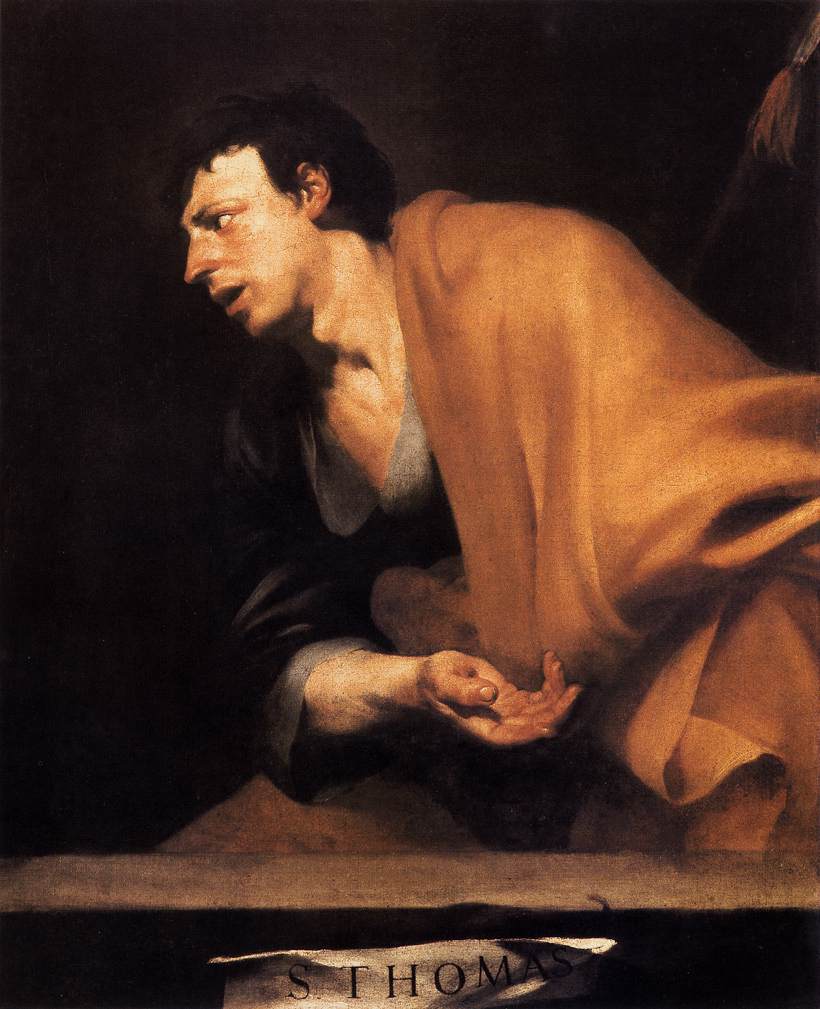
Feast of St Thomas the Apostle
"Dearly beloved brethren, what is it in this passage which particularly claimeth our attention? Think ye that it was by accident that this chosen Apostle was not with them when Jesus came? or, when he came, heard? or, when he heard, doubted? or, when he doubted, felt? or, when he had felt, believed? All these things were not accidental, but Providential. It was a wonderful provision of Divine mercy, that this incredulous disciple, by thrusting his fingers into the bodily Wounds of his Master, should apply a remedy to the spiritual wounds of unbelief in our souls. The doubts of Thomas have done us more good than the faith of all the disciples that believed. While he feeleth his way to faith, our minds are freed from doubt, and settled in faith.
Even as the Lord before his birth willed that Mary should be espoused, and yet never lose her virginity, so, after his Resurrection, he willed that his disciple should doubt, and yet not lose his faith. For, even as the espoused husband was the keeper of the virginity of the Mother, so was the disciple who doubted and felt, the witness of the truth of the Resurrection. He felt, and cried out: My Lord and my God. Jesus saith unto him: Thomas, because thou hast seen me, thou hast believed. When the Apostle Paul saith Faith is the substance of things hoped for, the evidence of things not seen, he plainly meaneth that faith is the evidence of things that cannot be seen. When they are seen, there remaineth not faith, but knowledge."
-- From a homily by St Gregory the Great
** Our brethren observing the 1962 Liturgical Calendar observe St Thomas the Apostle on 21 December.
Painting by Jusepe Martínez
Even as the Lord before his birth willed that Mary should be espoused, and yet never lose her virginity, so, after his Resurrection, he willed that his disciple should doubt, and yet not lose his faith. For, even as the espoused husband was the keeper of the virginity of the Mother, so was the disciple who doubted and felt, the witness of the truth of the Resurrection. He felt, and cried out: My Lord and my God. Jesus saith unto him: Thomas, because thou hast seen me, thou hast believed. When the Apostle Paul saith Faith is the substance of things hoped for, the evidence of things not seen, he plainly meaneth that faith is the evidence of things that cannot be seen. When they are seen, there remaineth not faith, but knowledge."
-- From a homily by St Gregory the Great
** Our brethren observing the 1962 Liturgical Calendar observe St Thomas the Apostle on 21 December.
Painting by Jusepe Martínez
Friday, July 2, 2010
The Visitation of the Blessed Virgin Mary
"As soon as our Redeemer was come among us, he went with haste, while as yet he was in his mother's womb, to visit his friend John. And John, in the one womb, as if conscious of the presence of Jesus in the other womb, dashed himself impatiently against the narrow walls of his natural prison, as though crying out: I perceive the very Lord that gave nature her bounds! Why therefore should I wait for the due season of my birth? What need is there for me to linger here till nine months are ended, now that the Timeless One is with me! I would break out of my dark cell! I would proclaim my manifold knowledge of marvellous things! I am meant to be a sign, and so even now I would shew that the Christ is here! I am the trumpet-voice, and I desire to peal forth the news that the Son of God is come in the flesh. Let me sound as a trumpet, and bless and loose my father's tongue, and make it speak again! Let me sound as a trumpet and quicken my mother's womb!
Thou seest, O brethren beloved, how new and how strange a mystery is here! John is not yet born, but by leaping he speaketh. He is as yet unseen, but he giveth warning. He is not yet able to cry, but by his acts he beareth witness. He draweth not yet the breath of life, but he preacheth God. He seeth not yet the light, but he maketh known the Sun. He is not yet come out of the womb, but he hasteth to play the Forerunner. In the presence of the Lord he cannot restrain himself, but rebelleth against the bounds set by nature, and struggleth to break out of the prisoning womb, eager to herald the coming Saviour. He saith, as it were: Behold, the Deliverer cometh, and why am I yet in bonds, and made to abide here? The Word cometh, that he may set right all things, and am I still to tarry in prison? I would go forth! I would run before him, and proclaim to all mankind: Behold the Lamb of God that taketh away the sin of the world.
But do thou tell us, O John, how it came to pass that while thou wast still in the darkness of thy mother's womb, thou didst see and hear? How didst thou behold the things of God? How didst thou leap and bound for joy? If we could hear him answer, he would say: Great is the mystery of that which here taketh place. Beyond the understanding of men are these doings! It is meet that I should shew forth a new thing in nature for the sake of him who is making new things which are beyond nature. Even though I be yet in the womb, I perceive, for forth upon me from another womb the Sun of Righteousness shineth. As it were, with mine ears I understand, for I was created to be the Voice of the Great Word. I would cry aloud, for I contemplate the only-begotten Son of the Father clothed in flesh. I tremble for joy, for I perceive that he, by whom all things were made, hath taken upon him the form of a servant. I leap as I think of the Redeemer of the world being made flesh, for I would run before his coming. Nonetheless, I herald his approach unto you as best I can, and make on this wise my confession of him whose Forerunner I am."
-- From a sermon by St John Chrysostom
** Painting by Juan Correa del Vivar
Thursday, July 1, 2010
The Most Precious Blood of Our Lord Jesus Christ
"John the Baptist has pointed out the Lamb, Peter has firmly established his throne, Paul has prepared the bride; their joint work, admirable in its unity, at once suggests the reason for their feasts occurring almost simultaneously in the cycle. The alliance being now secured, all three fall into shade; whilst the bride herself, raised up by them to such loftly heights, appears alone before us, holding in her hands the sacred cup of the nuptial-feast."
"This gives the key of today's solemnity, revealing how its appearance in the heavens of the holy liturgy at this particular season is replete with mystery. The Church, it is true, has already made known to the sons of the new covenant, in a much more solemn matter, the price of the Blood that redeemed them, its nutritive strength, and the adorng homage is its due. On Good Friday, earth and heaven beheld all sin drowned in the saving stream, whose eternal flood-gates at last gave way beneath the combined effort of man's violence and of the love of the divine Heart. The festival of Corpus Christi witnessed our prostrate worship before the altars whereon is perpetuated the Sacrifice of Calvary, and where the outpouring of the precious Blood affords drink to the humblest little ones, as well as to the mightiest potentates of earth, lowly bowed in adoration before it."
"How is it, then, that holy Church is now inviting all Christians to hail, in a particular manner, the stream of life ever gushing from the sacred fount? What else can this mean, but that the preceding solemnities have by no means exhausted the mystery? The peace which this Blood has made to reign in the high places as well as in the low; the impetus of its wave bearing back the sons of Adam from the yawning gulf, purified, renewed, and dazzling white in the radiance of their heavenly apparel; the sacred Table outspread before them on the waters' brink, and the chalice brimful of inebriation - all this preparation and display would be objectless, all these splendours would be incomprehensible, if man were not brought to see therein the wooings of a love that could never endure its advances to be outdone by the pretensions of any other. Therefore, the Blood of Jesus is set before our eyes at this moment as the Blood of the Testament; the pledge of the alliance proposed to us by God [Exodus 24: 8; Hebrews 9: 20]' the dower stipulated by eternal Wisdom for this divine union to which He is inviting all men, and its consummation in our soul which is being urged forward with such vehemence by the Holy Ghost."
"'Having therefore, brethren, a confidence in entering into the Holies by the Blood of Christ,' says the apostle, 'a new and living way which He hath dedicated for through the veil - that is to say, His flesh - let us draw near with a pure heart in fullness of faith, having our hearts sprinkled from an evil conscience, and our bodies washed with clean water, let us hold fast the confession of our hope without wavering, for He is faithful that hath promised. Let us consider one another to provoke unto charity and to good works [Hebrews 10: 19-24]. And may the God of peace who brought again from the dead the great Pastor of the sheep, our Lord Jesus Christ, in the Blood of the everlasting Testament, fit you in all goodness, that you may do His will: doing in you that which is well-pleasing in His sight, through Jesus Christ, to whom is glory forever and ever. Amen! [Hebrews 13: 20,21].'"
"Nor must we omit to mention here, that this feast is a monument of one of the most brilliant victories of holy Church in our own age. [Blessed Pope] Pius IX had been driven out from Rome in [November] 1848 by the triumphant revolution; but the following year, just about this season, his power was re-established. Under the aegis of the apostles on June 28 and the two following days, the eldest daughter of the Church [a former nickname for France], faithful to her past glories, swept the ramparts of the eternal city; and on July 2, Mary's festival [the feast of the Visitation on the traditional calendar], the victory was completed. Not long after this, a twofold decree notified to the city and the world the Pontiff's gratitude and the way in which he intended to perpetuate, in the sacred liturgy, the memory of these events."
"On August 10, from Gaeta itself [a town between Rome and Naples], the place of his exile in the evil day, [Blessed Pope] Pius IX, before returning to reassume the governments of his States, addressing himself to the invisible head of the Church, confided her in a special manner to His divine care, by the institution of this day's festival; reminding Him that it was for His Church that He had vouchsafed to shed all His precious Blood. Then, when the Pontiff re-entered his capital [on 12 April 1850, when he was finally assured that the French would not interfere in his affairs], turning to Mary, just as [Pope St.] Pius V and [Pope] Pius VIII had done under other circumstances, the Vicar of Christ solemnly attributed the honour of the recent victory to her who is ever the help of Christians; for on the feast of her Visitation it had been gained; and he now decreed that this said feast of July 2 should be raised from the rite of double major to that of second class throught the whole world [under the pre-1962 system of classifying feasts and holy days]. This was a prelude to the definition of the dogma of the Immaculate Conception, which the immortal Pontiff had already projected, whereby the crushing of the serpent's head would be completed."
Sanguis Christi, inebria me!
-- The Liturgical Year by Dom Prosper Guéranger
** Sadly enough, this feast is not celebrated, not even as an optional memorial, in the current liturgical calendar. But it is observed by those following the 1962 calendar.
Wednesday, June 30, 2010
We are all 'predestined to be made conformable to the image of His Son'
"Since contemplation is a gratuitous gift of God, is one justified in hoping for it?
Sometimes the question is asked whether it is not contrary to humility to hope for the gift of contemplation, and does not this open the door to illusions. Most Carmelite authors allow one to hope for it. Without excluding this hope, St Teresa thought it better to dispose oneself for it by humility and by the total gift of oneself to strive to realize the aim of their Institute, which is contemplation.
Can souls who thus dispose themselves to receive the gift of contemplation, merit this gift from God?
In the strict sense of the term merit, this is not possible, for contemplation is always a gratuitous gift. St Teresa and other Carmelite writers are quite firm on this point. But they are of the opinion that God rewards generous and faithful souls by giving it to them. This seems to lend authority to the opinion that one can merit contemplation in the wider meaning of the term."
Résumé
As will be evident from the foregoing, Carmelite life is especially directed towards contemplation. The soul seeks to meet God in solitude and silence. There it strives to detach itself from created things, to purify its faculties from everything that hinders its union with God, and to occupy itself with Him alone. The Carmelite concentrates all his thoughts on God. He seeks Him and contemplates Him in the light of faith, which alone enables him to attain God. He is drawn to God with all the ardor of his soul filled with love. Prayer is his principal occupation. The Carmelite devotes his whole day to this. Even while he works he strives to retain a spirit of prayer. In this recollection he glorifies God; gives himself to Him; and is full of zeal for His glory. He is not unconcerned for the welfare of other souls, but knows that he will save more souls, the more he is united with God.
Thus the Carmelite strives for this union in all his thoughts and actions. He knows that God invites him to do this. On the other hand, he is conscious of the fact that God gives Himself to souls only when they have left all for him. This is why, with his eyes fixed on Christ whom he strives to reproduce in himself, with his heart tending towards Him, he produces a void in himself to make room for God and gives himself to God in the hope of finally achieving union with Him in the measure that God deigns to communicate Himself here below.
Carmelite life is open to other souls
It has been our special purpose here to give an exposition of Carmelite ideals. But these teachings are not so completely the property of Carmel that they cannot be suitable to other souls as well. Indeed, grace makes us all 'partakers of the divine nature'; we are all 'predestined to be made conformable to the image of His Son'; we have all within us the Holy Spirit, who prays for us 'with unspeakable groanings.' All of us, if we have true charity, may hope that the Holy Trinity 'will make Their abode with us,' and that we will be united to Them.
However, we shall not attain to this union unless we carry out the necessary retrenchments, purifying our faculties, and tending towards God by the practice of the theological virtues and meditative prayer.
The Carmelite doctrine can be proposed as suited to every soul which seeks to unite itself with God. St John of the Cross is the Doctor of Mystical Theology for the universal Church. St Teresa has the title of 'mater spiritualium,' the mother of all things spiritual, 'whose heavenly teaching ought to nourish every soul.'"
-- The spirit and prayer of Carmel by François Jamart, ocd
** This is the last entry from this spiritual gem by Fr Jamart. For those of you who enjoyed the entries, you may use the Lijit search box and type "Jamart" to find all the posts from this book.
Sometimes the question is asked whether it is not contrary to humility to hope for the gift of contemplation, and does not this open the door to illusions. Most Carmelite authors allow one to hope for it. Without excluding this hope, St Teresa thought it better to dispose oneself for it by humility and by the total gift of oneself to strive to realize the aim of their Institute, which is contemplation.
Can souls who thus dispose themselves to receive the gift of contemplation, merit this gift from God?
In the strict sense of the term merit, this is not possible, for contemplation is always a gratuitous gift. St Teresa and other Carmelite writers are quite firm on this point. But they are of the opinion that God rewards generous and faithful souls by giving it to them. This seems to lend authority to the opinion that one can merit contemplation in the wider meaning of the term."
Résumé
As will be evident from the foregoing, Carmelite life is especially directed towards contemplation. The soul seeks to meet God in solitude and silence. There it strives to detach itself from created things, to purify its faculties from everything that hinders its union with God, and to occupy itself with Him alone. The Carmelite concentrates all his thoughts on God. He seeks Him and contemplates Him in the light of faith, which alone enables him to attain God. He is drawn to God with all the ardor of his soul filled with love. Prayer is his principal occupation. The Carmelite devotes his whole day to this. Even while he works he strives to retain a spirit of prayer. In this recollection he glorifies God; gives himself to Him; and is full of zeal for His glory. He is not unconcerned for the welfare of other souls, but knows that he will save more souls, the more he is united with God.
Thus the Carmelite strives for this union in all his thoughts and actions. He knows that God invites him to do this. On the other hand, he is conscious of the fact that God gives Himself to souls only when they have left all for him. This is why, with his eyes fixed on Christ whom he strives to reproduce in himself, with his heart tending towards Him, he produces a void in himself to make room for God and gives himself to God in the hope of finally achieving union with Him in the measure that God deigns to communicate Himself here below.
Carmelite life is open to other souls
It has been our special purpose here to give an exposition of Carmelite ideals. But these teachings are not so completely the property of Carmel that they cannot be suitable to other souls as well. Indeed, grace makes us all 'partakers of the divine nature'; we are all 'predestined to be made conformable to the image of His Son'; we have all within us the Holy Spirit, who prays for us 'with unspeakable groanings.' All of us, if we have true charity, may hope that the Holy Trinity 'will make Their abode with us,' and that we will be united to Them.
However, we shall not attain to this union unless we carry out the necessary retrenchments, purifying our faculties, and tending towards God by the practice of the theological virtues and meditative prayer.
The Carmelite doctrine can be proposed as suited to every soul which seeks to unite itself with God. St John of the Cross is the Doctor of Mystical Theology for the universal Church. St Teresa has the title of 'mater spiritualium,' the mother of all things spiritual, 'whose heavenly teaching ought to nourish every soul.'"
-- The spirit and prayer of Carmel by François Jamart, ocd
** This is the last entry from this spiritual gem by Fr Jamart. For those of you who enjoyed the entries, you may use the Lijit search box and type "Jamart" to find all the posts from this book.
Subscribe to:
Posts (Atom)