Sunday, November 7, 2010

Perform all actions under the influence of His grace and willingness to please Him

"We have spoken concerning the necessity of regulating one's understanding. It is necessary also to control one's will so that it is not abandoned to its own inclinations, but it is conformed entirely to the will of God.

It must be observed that it is not sufficient to desire, or even to execute what is most pleasing to God. It is also requisite to desire and to perform our action under the influence of His grace, and out of a willingness to please Him.

Here will arise the greatest struggle with our nature, constantly thirsty for its own pleasure. Even in lofty spiritual undertakings, it seeks its own satisfaction, residing there without the least scruple, since there is no apparent evil. The following is the result. We begin acts of religion not from the sole motive of doing the will of God, but for a sensible pleasure that often accompanies such acts.

The illusion is still more subtle as the object of our affection is more commendable in itself. Who would imagine that self-love, criminal as it is, should prompt us to unite ourselves to God? That in our desire to possess Him we should pursue our own interests rather than His glory and the accomplishment of His will, which should be the only motive for those who love Him, seek Him, and profess to keep His laws?

If we desire to avoid such a dangerous obstacle, we must accustom ourselves not to desire or execute anything unless it is through the impulse of the Holy Spirit, combined with a pure intention of honoring Him Who desires to be not only the first Principle, but also the last End of our every word and action, through the observance of the following method.

As soon as an opportunity presents itself to perform such a good action, we must prevent our heart from seizing on it before we have considered God. This will enable us to know whether it coincides with His will, and whether we desire it solely because it is pleasing to Him.

When our will is controlled and directed in this way by the will of God, it is motivated only with the desire to conform entirely to Him, and to further His glory. The same method is to be followed in rejecting whatever is contrary to His will. The first move is to raise our minds to God to know what is displeasing to Him, and then be satisfied that in its rejection we conform to His holy will.

We must remember that it is extremely difficult to discover the deceptions of our fallen nature. It is always fond of making itself, for very questionable motives, the focal point of all things; it flatters by persuading us that in all our actions our only motive is to please God. What we accept or reject, then, is actually done to please ourselves, while we erroneously imagine that we act out of a desire to please, or a dread of displeasing, our Sovereign Lord.

The most effective remedy against evil is purity of heart. Everyone engaged in the spiritual combat must be armed with it, discarding the old man and putting on the new. The remedy is applied in this way. In everything that we undertake, pursue, or reject, we divest ourselves of all human considerations, and do only what is conformable to the will of God.

It may happen that in many things we do, and especially in the interior impulses of the heart, or in swiftly transient exterior actions, we may not always be conscious of the influence of this motive. But at least we should be so disposed that virtually and habitually we act from the viewpoint of pleasing God.

In more prolonged activities this virtual intention is not sufficient. It should be frequently renewed and developed to its full stature in purity and fervor. Without this, we run the great risk of deception by self-love, which always prefers the creature to the Creator and so deceives that, in a short time, we are imperceptibly drawn from our primary intention. Well meaning but vulnerable persons generally set out with no other purpose than to please God. But by degrees they permit themselves, without knowing it, to be lured away by vanity. They for get the Divine will which first influenced them and are completely absorbed in the satisfaction afforded by their actions, and in the advantages and rewards they expect. If it happens that, while they think they are accomplishing, great things, Providence permits them to be interrupted by sickness or some accident, they are immediately dissatisfied, criticizing everyone about them, and sometimes even God Himself. This is clear evidence that the motive, the force behind their actions was bad.

Anyone who acts under the influence of Divine grace and only to please God is indifferent as to his course of action. Or, if he is inclined to some particular activity, he completely submits to Providence the manner and time of doing it. He is perfectly resigned to whatever success attends his undertakings, and his heart desires nothing but the accomplishment of the Divine will.

Therefore, let everyone examine himself, let him direct all his actions to this most excellent and noble end. If he discovers that he is performing a work of piety in order to avoid punishment, or to gain the rewards of the future life, he should establish as the end of his undertaking the will of God, Who requires that we avoid hell and gain Heaven.

It is not within man's power to realize the efficacy of this motive. The least action, no matter how insignificant, performed for His sake, greatly surpasses actions which, although of greater significance, are done for other motives.

For example, a small alms, given solely in honor of God, is infinitely more agreeable to Him than if, from some other motive, large possessions are abandoned, even if this is done from a desire to gain the kingdom of heaven. And this, in itself, is a highly commendable motive, and worthy of our consideration.

The practice of performing all of our actions solely from the intention of pleasing God may be difficult at first. With the passing of time it will become familiar and even delightful, if we strive to find God in all sincerity of heart, if we continually long for Him, the only and greatest Good, deserving to be sought, valued, and loved by all His creatures. The more attentively we contemplate the greatness and goodness of God, the more frequently and tenderly our affections will turn to that Divine Object. In this way we will more quickly, and with greater facility, obtain the habit of directing all our actions to His glory.

In conclusion, there is a final way of acting in complete accordance with this very excellent and elevated motive. This is fervently to petition our Lord for grace and frequently to consider the infinite benefits He has already given us, and which He continues to bestow every moment from an undeserved and disinterested affection."

-- Spiritual Combat by Lorenzo Scupoli

Saturday, November 6, 2010

Memorial of Bl Eduardo of the Child Jesus & companions


"Fr. Eduardo of the Child Jesus (Eduardo Farré Masip y Soler) was born April 20, 1897, in Torms in the Province of Lerida. The last-born of three, his mother died upon giving birth to him. He was known to be a very serious child and was not as playful as other children his age. It seemed that growing up without a mother’s love had affected him. This could have contributed to his introverted personality and character. His intelligence made him apt for studies.

Eduardo served as an altar boy for two years at the chapel of the Dominican nuns with Fr. Coll, OP. At the age of ten, he entered the minor seminary to begin his studies in the Humanities in which he excelled. When he was twelve years old, he was taken by a priest friend of the family, Fr. Deogracias, to the Carmelite monastery in Tarragona to continue his studies. He entered the novitiate in Tarragona at the age of fifteen and made his first profession on August 10, 1913, and solemn vows in 1916. As a student, Eduardo demonstrated an exceptional aptitude for literature. His poems were recognized by the Academia Mariana of Lerida and won prizes at Juegos Florales of San Andres-Barcelona.

Completing his studies in 1919, Eduardo was eight months away from the required age to he ordained. He was dispensed from this requirement, was ordained by Bishop Jose Miralles Shert in Lerida on June 13, 1920, and celebrated his first Mass at the Carmelite nuns’ monastery in Lerida. That same year, he was assigned to Durango and remained there for three years.

At this time, religious persecution in Mexico had targeted Fr. Eduardo; and he had to find refuge urgently. Friends of his were able to help him flee the country to the United States by disguising him as a newspaper reporter mounted on horseback. Through donations that he received for his preaching and ministry, he was able to pay for his journey to Tucson.

The Province assigned Fr. Eduardo prior of the monastery in Washington, DC, which had been inaugurated and blessed by Bishop Thomas Shanahan in the presence of Fr. José Maria Isasi and Fr. Pascasio on the feast day of St. Teresa of Avila on October 15, 1916. As prior in 1927, he faced critical issues regarding the running and operation of some properties there, which he was able to solve with the help of God.

After spending nine years in the Americas, Fr. Eduardo returned to Spain for the Provincial Chapter in 1930 where he was elected to the General Chapter as an associate. Although he was elected superior of the Carmelite monastery in Washington, DC, for a third term, he declined to take the position offered him and instead went to Guatemala to investigate the possibilities of establishing a Carmelite presence there. By the next Provincial Chapter in May 1936, he was elected prior of the monastery in Tarragona."


-- Text from the webpage of the Discalced Carmelite Friars of the California-Arizona Province.


"Fr. Eduardo, who was prior of the community in Tarragona at that time, was preaching a novena to Our Lady of Mt. Carmel to the Carmelite nuns in Tiana, for it was a custom at that monastery to begin the novena on the 16th. On the feast day of St. Elijah (July 20), Fr. Eduardo received news of the war and urged the nuns to be ready to leave the cloister. 

By midmorning, they saw their neighboring church on fire and rapidly changed into civilian clothes and left the cloister safely. Outside, before they parted to take refuge at family homes, the nuns knelt for a blessing from Fr. Eduardo who told them that this could be their last meeting—“until we meet again in heaven. ”Frs. Gabriel and Eduardo took refuge at the home of the Noruega family. 


The fathers found a welcoming and loving home where they could feel protected. Perhaps such notion of safety and optimism made the priests less cautious and fearless of their surroundings. The priests would secretly go to the nuns to celebrate Mass for them until it became too dangerous. At 6 o’clock in the evening of July 25, as the priests and family were at home, they saw about thirty militia men running in formation past the house with more riding in privately-owned vehicles. 


Some of them surrounded the Noruega’s house and entered through the door demanding to register and inspect the household. Mr. Noruega, realizing that the inspection might cost the lives of the priests, asked them what to do. Fr. Gabriel suggested that he tell them they were just friends of the family. 


However Fr. Eduardo with great fervor and courage strongly disagreed and said that they should know who they were. As the militia interrogated the family and turned to the priests, these words were heard: “Yes sir! We are two Discalced Carmelite friars!” They seized them immediately and took them to headquarters. The friars were transferred to a large truck where a woman armed with a rifle directed them on board. That was the last time they were seen. It is speculated that their bodies were buried in common graves perhaps near the town of Montcada. Fr. Eduardo died at the age of 39." 


-- From the Tucson priests blog.

Friday, November 5, 2010

Memorial of Bl Frances D'Amboise

"Duchess of Brittany, afterwards Carmelite nun, b. 1427; d. at Nantes, 4 Nov., 1485. The daughter of Louis d'Amboise, Viscount de Thouars, she was betrothed when only four years old, to Peter, second son of John V, Duke of Brittany, the marriage being solemnized when she had reached the age of fifteen. The union was, however, not very happy owing to the morose disposition of the husband who occasionally ill-treated his wife; but her gentleness gradually changed his heart, he assisted her in her works of charity and did penance for his former dissolute life. After his succession to the dukedom in 1450 her wholesome influence made itself felt in wider circles; she also intervened, not always successfully, in the never-ending family feuds. The duke died, leaving no legitimate heir, in 1457 after having borne testimony in his last will to the devotedness of his wife. The latter consecrated her life to God, but for several years she was unable to consummate the sacrifice by entering a convent. While being educated by her future mother-in-law she had early distinguished herself by almsdeeds and fervent devotion to the Blessed Sacrament. During her married life she devoted a large portion of her fortune to the foundation of a convent of Poor Clares at Nantes, which she would have joined had her strength allowed it; she also took part in the preliminaries of the canonization of St. Vincent Ferrer, became a benefactress of the Dominican convent at Nantes, and made the acquaintance of Blessed John Soreth, General of the Carmelites, who in 1452 had established the first community of Carmelite nuns. Some of these, coming from Liège, were received by Frances at Vannes (31 Oct., 1463) where they were entertained at the castle until the convent called "The Three Maries" was habitable. Having provided their dowries she entered the novitiate (25 March, 1468), making her profession the following year. After some time spent as infirmarian she was elected prioress for life (1473), and became by her splendid example the model of a true Carmelite nun, and, in a sense, the foundress of this branch of the order. The convent proving too small she obtained not without litigation, a larger one at Nantes. She died in a holy ecstasy, and miracles were wrought at her tomb. During the Huguenot wars and the French revolution her body had to be saved twice from profanation. Pius IX beatified her 16 July, 1863."

-- Biography from the Catholic Encyclopedia

Thursday, November 4, 2010

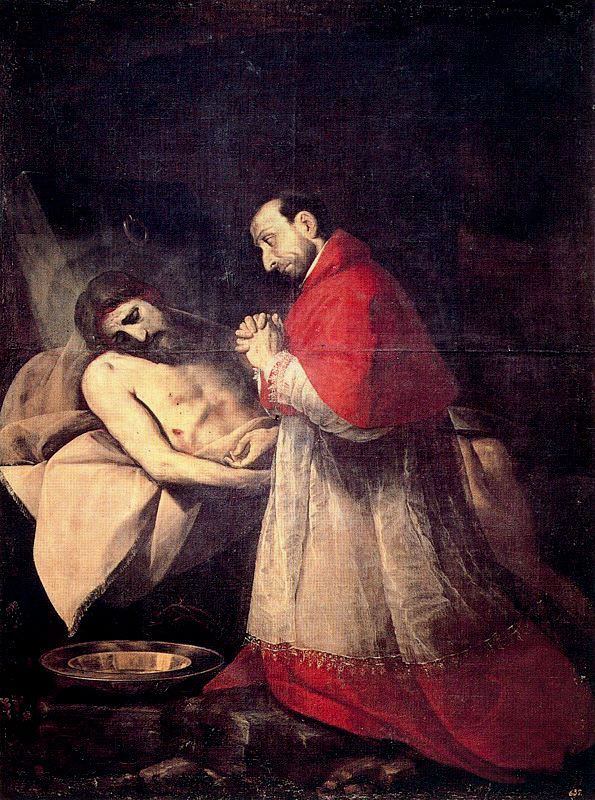
Memorial of St Charles Borromeo

"Charles, of the noble family of Borromeo, was born at Milan.  In foretoken of his holy life, God caused a bright light to shine by night over the chamber where his mother lay in travail.  As soon as his age would allow him, he received the tonsure.  When he was twelve years old, he was made Abbot but reminded his father that the revenues thereof were not be used as mere family property.  His father, to whom the administration of these revenues fell during his son's non-age, still gave them forthwith over to him, and whatever was left over, he gave to the poor.  While he was young he studied letters at Pavia.  He kept his purity thoroughly, so that he scared away the unclean women, of whom many were set upon him, to overthrow his self-control.  In the twenty-third year of his age, his uncle, Pius IV, made him a Cardinal, in which dignity he was a burning and shining light of godliness and all graces before the whole of the Sacred College.  About forty days afterwards the same Pope created him Archbishop of Milan.  As such it was his great desire to order the Church committed to his charge in accordance with the requirements of the most holy Council of Trent, which was in great part by his labours brought to a conclusion.  To raise up the degraded lives of the people, he oftentimes held Synods, but himself set an example of deep godliness.  He worked earnestly to purge the parts about the Alps and borders of Switzerland of heresy, and brought many of the heretics to the Christian faith.

Charity was the brightest mark of his life.  His principality of Oria he sold for forty thousand crowns, and gave the whole sum to the poor in one day.  Twenty thousand crowns being left him as a legacy he gave the whole to the poor.  The incomes of the benefices wherewith he had been loaded by his uncle, he spent upon the needs of the poor, except what he used for himself.  When the plague grievously raged in Milan, he gave up to the sick poor the furniture of his own house, even to his own bedding, and thenceforward slept upon the boards.  He constantly visited the sick, cheered them by his fatherly kindness, and wonderfully comforted them, ministering to them with his own hands the Sacraments of the Church.  At the same time he drew near to plead for them with God in lowly entreaty, and ordered a public Procession wherein he walked himself carrying a Cross, with a rope halter round his neck, and his bare feet bleeding from the stones, and fain to turn away the Divine anger by offering himself as a scapegoat for the sins of his people.  He was a stout defender of the freedom of the Church.  But in the Church he was an earnest reformer of discipline, and once, when he was engaged in prayer, some conspirators took a shot at him with a blunderbuss, but, though the ball struck him, the power of God kept him unharmed.

He was remarkable for his abstinence.  He very often fasted upon nothing but bread and water, and sometimes nothing but lupines.  He tamed his body by depriving himself of sleep, by very rough haircloth, and by constant scourging.  He was an earnest practiser of lowliness and meekness.  However much he was taken up with business, he never gave himself relaxation from prayer and from preaching the word of God.  He built many churches, convents, and schools.  He wrote much matter, useful more especially for the good of Bishops.  The publication of the Parish Priests' Catechism was due to his care.  In October 1584, he withdrew himself, for the purpose of making a retreat, to the Sacro Monte of Varallo, an hill whereon the incidents of the Lord's sufferings are represented in life-size groups of coloured figures.  He was taken ill of an ague, and lived there for some days a life of torture by voluntary suffering, but of sweetness by thoughts of Christ's woes.  After his return to Milan, his sickness became hopeless, and early in the night between the 3rd and 4th days of November, in the 47th year of his own age, and in that of our Lord 1584, covered with ashes and sackcloth, and with his eyes fixed upon the image of Christ crucified, he exchanged earth for heaven.  He was famous for miracles, and Pope Paul V numbered him among the Saints."

-- From the Breviary of St Pius X (1955 ed)

** Painting by Giovanni Battista Crespi il Cerano

Wednesday, November 3, 2010

The prayer of the church is the prayer of the ever-living Christ

""Through him, with him, and in him in the unity of the Holy Spirit, all honor and glory is yours, Almighty Father, for ever and ever." With these solemn words, the priest ends the eucharistic prayer at the center of which is the mysterious event of the consecration. These words at the same time encapsulate the prayer of the church: honor and glory to the triune God through, with, and in Christ. Although the words are directed to the Father, all glorification of the Father is at the same time glorification of the Son and of the Holy Spirit. Indeed, the prayer extols the majesty that the Father imparts to the Son and that both impart to the Holy Spirit from eternity to eternity.

All praise of God is through, with, and in Christ. Through him, because only through Christ does humanity have access to the Father and because his existence as God-man and his work of salvation are the fullest glorification of the Father; with him, because all authentic prayer is the fruit of union with Christ and at the same time buttresses this union, and because in honoring the Son one honors the Father and vice versa; in him, because the praying church is Christ himself, with every individual praying member as a part of his Mystical Body, and because the Father is in the Son and the Son the reflection of the Father, who makes his majesty visible. The dual meanings of through, with, and in clearly express the God-man's mediation.
The prayer of the church is the prayer of the ever-living Christ. Its prototype is Christ's prayer during his human life.

1. The Prayer of the Church as Liturgy and Eucharist

The Gospels tell us that Christ prayed the way a devout Jew faithful to the law prayed. Just as he made pilgrimages to Jerusalem at the prescribed times with his parents as a child, so he later journeyed to the temple there with his disciples to celebrate the high feasts. Surely he sang with holy enthusiasm along with his people the exultant hymns in which the pilgrim's joyous anticipation streamed forth: "I rejoiced when I heard them say: Let us go to God's house." (Ps 122:1) From his last supper with his disciples, we know that Jesus said the old blessings over bread, wine, and the fruits of the earth, as they are prayed to this day. So he fulfilled one of the most sacred religious duties: the ceremonial passover seder to commemorate deliverance from slavery in Egypt. And perhaps this very gathering gives us the profoundest glimpse into Christ's prayer and the key to understanding the prayer of the church.

While they were at supper, he took bread, said the blessing, broke the bread, and gave it to his disciples, saying, "Take this, all of you, and eat it: this is my body which will be given up for you."
In the same way, he took the cup, filled with wine. He gave you thanks, and giving the cup to his disciples, said, "Take this, all of you, and drink from it: this is the cup of my blood, the blood of the new and everlasting covenant. It will be shed for you and for all so that sins may be forgiven."

Blessing and distributing bread and wine were part of the passover rite. But here both receive an entirely new meaning. This is where the life of the church begins. Only at Pentecost will it appear publicly as a Spirit-filled and visible community. But here at the passover meal the seeds of the vineyard are planted that make the outpouring of the Spirit possible. In the mouth of Christ, the old blessings become life-giving words. The fruits of the earth become his body and blood, filled with his life. Visible creation, which he entered when he became a human being, is now united with him in a new, mysterious way. The things that serve to sustain human life are fundamentally transformed, and the people who partake of them in faith are transformed too, drawn into the unity of life with Christ and filled with his divine life. The Word's life-giving power is bound to the sacrifice. The Word became flesh in order to surrender the life he assumed, to offer himself and a creation redeemed by his sacrifice in praise to the Creator. Through the Lord's last supper, the passover meal of the Old Covenant is converted into the Easter meal of the New Covenant: into the sacrifice on the cross at Golgotha and those joyous meals between Easter and Ascension when the disciples recognized the Lord in the breaking of bread, and into the sacrifice of the Mass with Holy Communion.

As the Lord took the cup, he gave thanks. This recalls the words of blessing thanking the Creator. But we also know that Christ used to give thanks when, prior to a miracle, he raised his eyes to his Father in heaven. He gives thanks because he knows in advance that he will be heard. He gives thanks for the divine power that he carries in himself and by means of which he will demonstrate the omnipotence of the Creator to human eyes. He gives thanks for the work of salvation that he is permitted to accomplish, and through this work, which is in fact itself the glorification of the triune Godhead, because it restores this Godhead's distorted image to pure beauty. Therefore the whole perpetual sacrificial offering of Christ at the cross, in the holy Mass, and in the eternal glory of heaven can be conceived as a single great thanksgiving as Eucharist: as gratitude for creation, salvation, and consummation. Christ presents himself in the name of all creation, whose prototype he is and to which he descended to renew it from the inside out and lead it to perfection. But he also calls upon the entire created world itself, united with him, to give the Creator the tribute of thanks that is his due. Some understanding of this eucharistic character of prayer had already been revealed under the Old Covenant. The wondrous form of the tent of meeting, and later, of Solomon's temple, erected as it was according to divine specifications, was considered an image of the entire creation, assembled in worship and service around its Lord. The tent around which the people of Israel camped during their wanderings in the wilderness was called the "home of God among us" (Ex 38:21). It was thought of as a "home below" over against a "higher home." "O Lord, I love the house where you dwell, the place where your glory abides," sings the Psalmist (Ps 26:8), because the tent of meeting is "valued as much as the creation of the world." As the heavens in the creation story were stretched out like a carpet, so carpets were prescribed as walls for the tent. As the waters of the earth were separated from the waters of the heavens, so the curtain separated the Holy of Holies from the outer rooms. The "bronze" sea is modeled after the sea that is contained by its shores. The seven- branched light in the tent stands for the heavenly lights. Lambs and birds stand for the swarms of life teeming in the water, on the earth, and in the air. And as the earth is handed over to people, so in the sanctuary there stands the high priest "who is purified to act and to serve before God." Moses blessed, anointed, and sanctified the completed house as the Lord blessed and sanctified the work of his hands on the seventh day. The Lord's house was to be a witness to God on earth just as heaven and earth are witnesses to him (Dt 30:19).

In place of Solomon's temple, Christ has built a temple of living stones, the communion of saints. At its center, he stands as the eternal high priest; on its altar he is himself the perpetual sacrifice. And, in turn, the whole of creation is drawn into the "liturgy," the ceremonial worship service: the fruits of the earth as the mysterious offerings, the flowers and the lighted candlesticks, the carpets and the curtain, the ordained priest, and the anointing and blessing of God's house. Even the cherubim are not missing. Fashioned by the hand of the artist, the visible forms stand watch beside the Holy of Holies. And, as living copies of them, the "monks resembling angels" surround the sacrificial altar and make sure that the praise of God does not cease, as in heaven so on earth. The solemn prayers they recite as the resonant mouth of the church frame the holy sacrifice. They also frame, permeate, and consecrate all other "daily work," so that prayer and work become a single opus Dei, a single "liturgy." Their readings from the holy Scriptures and from the fathers, from the church's menologies and the teachings of its principal pastors, are a great, continually swelling hymn of praise to the rule of providence and to the progressive actualization of the eternal plan of salvation. Their morning hymns of praise call all of creation together to unite once more in praising the Lord: mountains and hills, streams and rivers, seas and lands and all that inhabit them, clouds and winds, rain and snow, all peoples of earth, every class and race of people, and finally also the inhabitants of heaven, the angels and the saints. Not only in representations giving them human form and made by human hands are they to participate in the great Eucharist of creation, but they are to be involved as personal beings or better, we are to unite ourselves through our liturgy to their eternal praise of God.

"We" here refers not just to the religious who are called to give solemn praise to God, but to all Christian people. When these stream into cathedrals and chapels on holy days, when they joyously participate daily in worship using the "people's choral Mass" and the new "folk Mass" forms, they show that they are conscious of their calling to praise God. The liturgical unity of the heavenly with the earthly church, both of which thank God "through Christ," finds its most powerful expression in the preface and Sanctus of the Mass. However, the liturgy leaves no doubt that we are not yet full citizens of the heavenly Jerusalem, but pilgrims on the way to our eternal home. We must always prepare ourselves before we may dare to lift our eyes to the luminous heights and to unite our voices with the "holy, holy, holy" of the heavenly chorus. Each created thing to be used in the worship service must be withdrawn from its profane use, must be purified and consecrated. Before the priest climbs the steps to the altar, he must cleanse himself by acknowledging his sins, and the faithful must do so with him. Prior to each step as the offertory continues, he must repeat his plea for the forgiveness of sins for himself and for those gathered around him as well as for all to whom the fruits of the sacrifice are to flow. The sacrifice itself is a sacrifice of expiation that transforms the faithful as it transforms the gifts, unlocks heaven for them, and enables them to sing a hymn of praise pleasing to God. All that we need to be received into the communion of saints is summed up in the seven petitions of the Our Father, which the Lord did not pray in his own name, but to instruct us. We say it before communion, and when we say it sincerely and from our hearts and receive communion in the proper spirit, it fulfills all of our petitions. Communion delivers us from evil, because it cleanses us of sin and gives us peace of heart that takes away the sting of all other "evils." It brings us the forgiveness of past sins and strengthens us in the face of temptations. It is itself the bread of life that we need daily to grow into eternal life. It makes our will into an instrument at God's disposal. Thereby it lays the foundation for the kingdom of God in us and gives us clean lips and a pure heart to glorify God's holy name.

So we see again how the offertory, communion, and the praise of God [in the Divine Office] are internally related. Participation in the sacrifice and in the sacrificial meal actually transforms the soul into a living stone in the city of God in fact, each individual soul into a temple of God."

-- The Prayer of the Church by St Teresa Benedicta of the Cross

Tuesday, November 2, 2010

In purgatory, the more the soul is consumed, the more it exposes itself to God

"I don't believe there can be found a comparable contentment to that of a soul in purgatory, if you except the saints that are in heaven. Each day this contentment increases through God's action in those souls, and this action keeps augmenting at the same time as all that impedes this divine action burns away. This impediment is the rust of sin. Fire slowly consumes this rust and thus the soul exposes itself more and more to the divine influx.

Just like an object shrouded by something cannot respond to the radiance of the sun - not because the sun is insufficient since it keeps on shining but because of the impediment caused by what is wrapping the object. If the obstacle that acts as a screen is burnt away, the object will expose itself to the action of the sun; it will experience this action in proportion to the diminution of the obstacle. Thus the rust of sin is what shrouds the soul.

In purgatory this rust is consumed by fire. The more it is consumed, the more the soul exposes itself to the true sun which is God. Its joy increases as the rust disappears and the soul is exposed to the divine ray of sun. Thus the one increases and the other diminishes until the time is accomplished. Suffering isn't what diminishes, only the time to spend in that pain becomes shorter.

The souls that are in purgatory find themselves without the guilt of sin. Consequently, there is no obstacle between God and them besides this suffering that hinders them and consists in that their beatific instinct hasn't reached its full perfection."

-- Treatise on Purgatory by St Catherine of Genoa

Monday, November 1, 2010

Feast of All Saints

"Today the Church takes time to celebrate the feast of all the saints in Heaven. When we consider all the saints, of course, we normally think about the saints whose names are known to all of us, the great heroes of our Faith, the ones we can hold up as an example for everybody to be able to see what the Christian life is to be. Yet, we know at the same time, from the vision of Saint John, that he did not only see three or four thousand people - the canonized saints - but rather, he saw a multitude of people from every language, nation, race and people. It was a countless number. And so we understand, then, that there are many thousands of saints who are unknown to most people. They have lived their lives. They have "fought the fight", they have "run the race", as Saint Paul says. They have kept the Faith. And the merited crown that awaited them has now been awarded to them. Their names may not be known to us on earth, but they are known in the Book of Life in Heaven. These are the people, now, who glorify God for eternity. But these are the same ones who glorified God in their lives. Maybe they were not the ones who were outstanding, heroic persons; but rather, they were the ordinary saints, as opposed to the extraordinary ones - the ordinary saints, like you and me. They were the ones who were husbands and wives, mothers and fathers, the ones who were students, the ones who did their work in the way that God wanted them to.

We stop to ask ourselves: "How does one become a saint?" It begins, as we hear in the Book of Revelation, by being sealed with the seal of the living God. Each one of us has received that seal; each one of us has been baptized into Jesus Christ, and the seal of the living God has been placed upon us. From the day that you are baptized, and for the rest of eternity, there is a seal, a mark, upon your soul. It will be evident, both in Heaven and in hell, who was baptized. It will be very clear who has the seal of the living God.

But it is not enough just to say, "I am baptized, therefore, I am going to Heaven." It does not work that way. We know that we can lose grace. We know that we can fall away from God. We need, then, to ask ourselves: "What is next?" We need to strive for holiness. Saint John tells us in the second reading today that we are going to be like Christ. "What we will be," he says, "has not yet come to light, but we know that when it does we will be like Him, for we will see Him as He is." We will be molded to Christ; we will be transformed into Christ. But that transformation begins now. If we are going to live a good Christian life, even just to truly call ourselves Christian people, it means that we need to have time set aside every single day for prayer, that we need to be developing that relationship with Jesus Christ, that we need to become more like Him in our day-to-day lives.

What would that look like? That looks just like the Beatitudes; that is the life of Christ encapsulated in nine little statements. That is what we need to be about: striving for that kind of holiness. But, on a practical level, to be a saint is very simple: it is to pray every day, it is to live a moral life, it is to stay very close to the Sacraments: to get to Mass, to get to Confession regularly. But in the day-to-day, minute-to-minute lives that we are all called to live, to be a saint is all encapsulated in one little term: obedience. It is just that simple: obedience to the duties of our state in life and to do those duties with the greatest amount of love that we can do them with. In doing that we will be saints.

To say that we are to be obedient to the duties of our state in life is to be obedient, first and foremost, to our baptismal vows, where we rejected Satan and we said "yes" to God. That encapsulates those points that I have already mentioned: to pray, to live a moral life, to frequent the Sacraments. For those who are married, it is to be faithful to your marriage vows - completely faithful to them -loving that other person (whom you sometimes do not feel like loving very much) and making sure that you are placing that person as the priority, pouring yourself out for your children, as well. And for the children, that means being obedient to your parents. It means being the best student that you can be, doing your work to the best of your ability - not complaining, not whining, not throwing your books on the floor and doing things like that, not putting them in your backpack and telling Mom that you already did your homework when you really did not. It means to do your chores. It means to clean your room and do all the things you are expected to do, and to do it in the best way that you can do it. So, again, that means willingly and even joyfully, not kicking and screaming, not complaining. And that does not only go for the kids, that goes for the adults as well. All the duties of our state in life, not to kick and moan and scream about them, but to accept them and to offer that up in union with Christ. It is to mold ourselves to be like Him.

So when we think about it, we have these extraordinary saints, the ones whose names we all know, and we could say that, in essence, they are like Our Lord in His public life. These are the ones who did great things. God worked miracles through them. He used them to bring conversions of many thousands of people, sometimes. He preached through them. He touched people's lives through them. But most people are not going to be that way. That was only three years of Our Lord's life. What happened for the first thirty? They were hidden.

And so if you think about it, a very small percentage of the Christian population is going to be extraordinary saints. The vast majority is going to be likened to the hidden life of Christ. They are going to be the unknown saints - but people who are in love with Jesus Christ, people who are striving in their day-to-day lives to live the Faith that they profess. That is what we are called to, each and every one of us. If God wants us to be extraordinary saints, then we need to be obedient to that and do His Will. But for most, He is calling us to live like that hidden life, to live a family life, to live a life of heroic love shown in little things. That is the way that Christ is asking each of us to become a saint: to do what we are supposed to do in the best way that we can. And in that we will be molded into Jesus Christ in this life so that we will be prepared to become like Him in the next, to see Him face-to-face and be transformed into Christ, to be one of those who have indeed survived the period of great trial and have washed our robes and made them white in the blood of the Lamb."

-- From a homily by Fr Robert Altier, ocds (1 November 2001)