
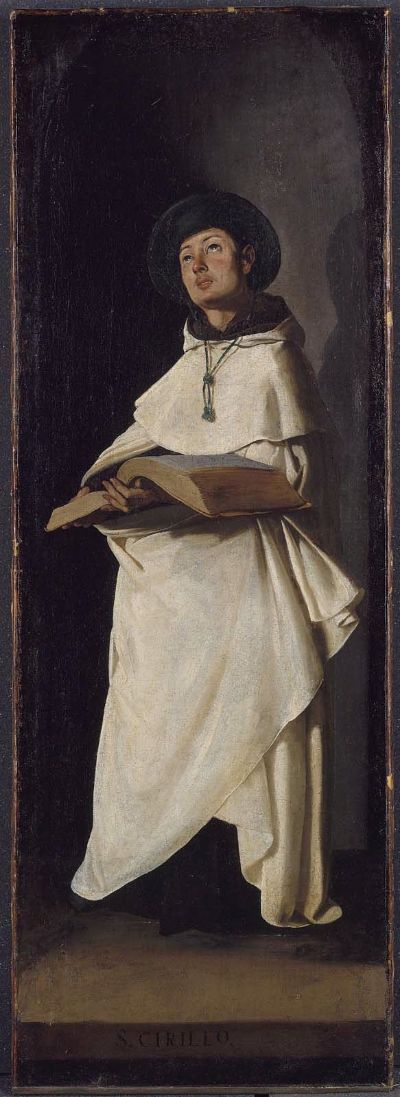
Saturday, March 6, 2010
Memorial of St Cyril of Constantinople
"Cyril, the Bishop of Alexandria, was born of noble parents. He was nephew, on the father's side, of Theophilus, then Bishop of Alexandria, who sent the youth to Athens to pursue his studies. There Cyril made marked progress, and he afterwards sought out John, the Bishop of Jerusalem, that he might be thoroughly instructed in the perfection of christian life. Strengthened by his intercourse with the Bishop, Cyril retired to Mount Carmel, where he led for some time the life of heaven upon earth, in company with certain pious men who dwelt there. Later he returned to Alexandria, his native city, and was ordained a priest of that church. Shortly afterwards, Theophilus died, who was Bishop, as well as Cyril's uncle, and Cyril was raised to the vacant seat by general consent.
As Bishop he gave himself up wholly to the duties of the episcopal charge. In the first place, that he might purge his diocese of the errors of unbelievers, he drove the Jews out of Alexandria, for they were then undermining the city by their evil lives. He attached also the Nestorian heretics, and he was therefore appointed the legate of Celestine the First, at the Council of Ephesus, where he uprooted almost entirely the baneful dogma of the Nestorians, and proved the Blessed Virgin Mary to be the true mother of God.
The old enemy of the human race, and of the Mother of God, raised up many persecutions against Cyril by means of John (Sacrensis), who represented the Emperor at Ephesus. Cyril was divinely aided in warding off these attacks; and after his return to Alexandria he wrote many letters to the different parts of Egypt, in order to blot out what remained of the Nestorian heresy. He wrote much and labored much in defence of the Church, and his works are read in the divine office throughout almost the whole of Syria. After he had ruled his church in holiness for many years, being bowed down with age, he gave up his soul to God on the fourth of the Kalends of February, under the Emperors Theodosius and Valentinian.
-o-
Father of heavenly light! who, with the light of wisdom and of the true faith, hast vouchsafed to enlighten the mind of Blessed Cyril, thy Confessor and Pontiff, that he might defend the honor of Mary, the Mother of Thy Son and ever Virgin, from the errors of heretics; grant, through his intercession, that the hearts of them that go astray may return to the unity of Thy truth, and that we may be on in obedience to Thy will. Through our Lord."
-- Proper Offices of the Saints granted to the Barefooted Carmelites (1896)
As Bishop he gave himself up wholly to the duties of the episcopal charge. In the first place, that he might purge his diocese of the errors of unbelievers, he drove the Jews out of Alexandria, for they were then undermining the city by their evil lives. He attached also the Nestorian heretics, and he was therefore appointed the legate of Celestine the First, at the Council of Ephesus, where he uprooted almost entirely the baneful dogma of the Nestorians, and proved the Blessed Virgin Mary to be the true mother of God.
The old enemy of the human race, and of the Mother of God, raised up many persecutions against Cyril by means of John (Sacrensis), who represented the Emperor at Ephesus. Cyril was divinely aided in warding off these attacks; and after his return to Alexandria he wrote many letters to the different parts of Egypt, in order to blot out what remained of the Nestorian heresy. He wrote much and labored much in defence of the Church, and his works are read in the divine office throughout almost the whole of Syria. After he had ruled his church in holiness for many years, being bowed down with age, he gave up his soul to God on the fourth of the Kalends of February, under the Emperors Theodosius and Valentinian.
-o-
Father of heavenly light! who, with the light of wisdom and of the true faith, hast vouchsafed to enlighten the mind of Blessed Cyril, thy Confessor and Pontiff, that he might defend the honor of Mary, the Mother of Thy Son and ever Virgin, from the errors of heretics; grant, through his intercession, that the hearts of them that go astray may return to the unity of Thy truth, and that we may be on in obedience to Thy will. Through our Lord."
-- Proper Offices of the Saints granted to the Barefooted Carmelites (1896)
Friday, March 5, 2010
Carmelite Saints video litany -- repost
Dear readers,
I noticed today that the Carmelite Saints Litany in Flickr is acting bizarrely when you come into the blog. As such, I deleted the post. You may find the litany by visiting this link.
Cheers!
-o-
Original post below:
Carmelite Saints video litany
Yesterday, Mrs Elena María Vidal from Fountain of Elias posted the link for a beautiful "Carmelite Saints Litany". I've never seen anything like it. Though it's missing some saints and blesseds (e.g., the parents of St Thérèse), it's graphical presentation is really delightful.
All Carmelite Saints, pray for us!
I noticed today that the Carmelite Saints Litany in Flickr is acting bizarrely when you come into the blog. As such, I deleted the post. You may find the litany by visiting this link.
Cheers!
-o-
Original post below:
Carmelite Saints video litany
Yesterday, Mrs Elena María Vidal from Fountain of Elias posted the link for a beautiful "Carmelite Saints Litany". I've never seen anything like it. Though it's missing some saints and blesseds (e.g., the parents of St Thérèse), it's graphical presentation is really delightful.
All Carmelite Saints, pray for us!
The Holy Shroud
"St. Francis De Sales was one of the Bishops who held the Holy Shroud when it was shown to the people during its Exposition in 1613. Because of the heat of the day the Archbishop of Turin warned St. Francis to be careful lest his sweat fall upon the Shroud. St. Francis De Sales refers to this incident in a letter to St. Jane Francis De Chantal, co-foundress with him of the Nuns of the Visitation, and also deeply devoted to the Holy Shroud. "It occurred to me to tell him"' he wrote, "That Our Lord was not so dainty, and that He shed His Blood and sweat for no other purpose than to mix them with ours, and give them as the price of eternal life.
St. John Bosco (1815 - 1888) was another Saint deeply devoted to the Shroud. While a student at the nearby Franciscan School at Chieri, John Bosco, together with his companions, would walk to Turin on Sunday to visit the Chapel of the Holy Shroud before going to the Jesuit church to hear instructions on Christian Doctrine.
St. Pius X, during his holy pontificate, approved the Oeuvre St. Luc, founded by Emanuel Faure, for the sole purpose of promoting veneration of the image of Christ revealed by the photograph of the Holy Shroud. His Holiness called this "The True Image of the Holy Shroud"' and declared that it can be an effective means in meditating on the Passion and Death of the Divine Savior. He expressed the desire that it be held in veneration in all Christian families. To this end, he recommended it to all Bishops and Priests and gave a special blessing to all who would propagate the image and cult of the Shroud."
-- From the website Holy Face of Jesus
** Traditionally, the Holy Shroud is commemorated on the Friday after the second Sunday in Lent. This feast also has its own Mass.
St. John Bosco (1815 - 1888) was another Saint deeply devoted to the Shroud. While a student at the nearby Franciscan School at Chieri, John Bosco, together with his companions, would walk to Turin on Sunday to visit the Chapel of the Holy Shroud before going to the Jesuit church to hear instructions on Christian Doctrine.
St. Pius X, during his holy pontificate, approved the Oeuvre St. Luc, founded by Emanuel Faure, for the sole purpose of promoting veneration of the image of Christ revealed by the photograph of the Holy Shroud. His Holiness called this "The True Image of the Holy Shroud"' and declared that it can be an effective means in meditating on the Passion and Death of the Divine Savior. He expressed the desire that it be held in veneration in all Christian families. To this end, he recommended it to all Bishops and Priests and gave a special blessing to all who would propagate the image and cult of the Shroud."
-- From the website Holy Face of Jesus
** Traditionally, the Holy Shroud is commemorated on the Friday after the second Sunday in Lent. This feast also has its own Mass.
Thursday, March 4, 2010
Memorial of Bl Romaeus
"Romaeus, a native of Italy, trampled under foot the world's allurements, of which he feared the dangers' and obeying the call of God to a religious life, he joined the Order of the Blessed Virgin Mary of Mount Carmel. Having entered there, he rejoiced as a giant to run the way, and he exercised himself with ardent zeal in this training school of the virtues. When Saint Avertanus, led by the spirit of God, undertook his pious pilgrimage to the Holy Places, he greatly desired to have Romaeus for his companion, because Romaeus was a model of piety. His request was granted by the superiors.
It is almost beyond belief how eagerly both companions started on their journey. They bore with brave and steadfast hearts the hardships of travel, as well as the want of necessary things; and upheld by the divine protection, they overcame the dangers and even the hazards to live, which, at that period especially, beset the steps of travellers. They were ever absorbed in the meditation of heavenly things, recalling to mind the acts of the Saints; and while they carried out their pious understanding, they vied with one another, and urged each other on to greater perfection.
They visited all the places of especial sanctity with sentiments of deep devotion, particularly those of Rome, which are hallowed by the blood of the Princes of the Apostles, and by that of many martyrs, and are renowned for the deeds and relics of numberless other heroes of Christ. At length, laden with spiritual treasures, they turned their faces homewards, and first Avertanus ended the course of his mortal life at Lucca. Romaeus, bereaved of his companion, longed ardently to rejoin him in Heaven. God heard his prayer, and Romaeus was stricken with the fever, which quickly increased in violence, so that he piously received the last Sacraments. Immediately afterwards he was rapt in ecstasy, wherein he saw the gentle Jesus coming to meet him with a multitude of Saints, amongst whom he recognized Avertanus. Upon the eight day after the death of the latter, Romaeus took flight to Heaven. His remains, together with those of his companion, first received public religious honor in the church of St Peter Major, without the walls. Afterwards they were carried from place to place, and they are now at length venerated in the church of Saints Paulinus and Donatus, where the faithful enjoy the fruits of his intercession. Pope Gregory the Sixteenth lately approved the honors which had been unceasingly paid him during four centuries, and graciously granted an Office in his honor."
-o-
O God! who hast led by the path of righteousness the Blessed Romaeus when he travelled with Thy servant, Avertanus; grant that, aided and protected by his intercession, we may be conducted to our country in Heaven."
-- Proper Offices of the Saints granted to the Barefooted Carmelites (1896)
It is almost beyond belief how eagerly both companions started on their journey. They bore with brave and steadfast hearts the hardships of travel, as well as the want of necessary things; and upheld by the divine protection, they overcame the dangers and even the hazards to live, which, at that period especially, beset the steps of travellers. They were ever absorbed in the meditation of heavenly things, recalling to mind the acts of the Saints; and while they carried out their pious understanding, they vied with one another, and urged each other on to greater perfection.
They visited all the places of especial sanctity with sentiments of deep devotion, particularly those of Rome, which are hallowed by the blood of the Princes of the Apostles, and by that of many martyrs, and are renowned for the deeds and relics of numberless other heroes of Christ. At length, laden with spiritual treasures, they turned their faces homewards, and first Avertanus ended the course of his mortal life at Lucca. Romaeus, bereaved of his companion, longed ardently to rejoin him in Heaven. God heard his prayer, and Romaeus was stricken with the fever, which quickly increased in violence, so that he piously received the last Sacraments. Immediately afterwards he was rapt in ecstasy, wherein he saw the gentle Jesus coming to meet him with a multitude of Saints, amongst whom he recognized Avertanus. Upon the eight day after the death of the latter, Romaeus took flight to Heaven. His remains, together with those of his companion, first received public religious honor in the church of St Peter Major, without the walls. Afterwards they were carried from place to place, and they are now at length venerated in the church of Saints Paulinus and Donatus, where the faithful enjoy the fruits of his intercession. Pope Gregory the Sixteenth lately approved the honors which had been unceasingly paid him during four centuries, and graciously granted an Office in his honor."
-o-
O God! who hast led by the path of righteousness the Blessed Romaeus when he travelled with Thy servant, Avertanus; grant that, aided and protected by his intercession, we may be conducted to our country in Heaven."
-- Proper Offices of the Saints granted to the Barefooted Carmelites (1896)
Wednesday, March 3, 2010
Memorial of Bl Jacobinus
"Jacobinus of Canepacia was born in the village of Plascha, within the diocese of Vercelli, in the year 1438. His parents were well known for their inborn uprightness of character, but they were poor in worldly goods. Jacobinus was piously trained from early youth, and he grew in years and in virtue alike. His devotion to the Mother of God, in particular, ever increased, and he determined to serve her by joining some Order which was especially devout towards her. He strove, by every means in his power, to make his vocation sure, and for this end, to constant prayer he added bodily mortification, fasting, and penance. At length he asked to be admitted amongst the lay Carmelites of the Primitive Observance and his request was granted.
During the novitiate, and still more after he had made his solemn vows to God, Jacobinus chose all sorts of austerities as the inheritance which by right belonged to him. He fasted on bread and water upon four days in each week; and on Feast Days and Thursdays the only relaxation of penance that he allowed himself was to devote himself with greater earnestness to prayer, in which he passed many hours continuously before the Blessed Sacrament, or at the altar of the Virgin Mother of God. By the will of his Superior he was sent to collect alms, and he discharged his duty for a long time. Such was his humility, piety, and zealous charity that all were moved by his admonitions to walk in the footsteps of the Saints.
Worn out with years, labors, and sickness, Jacobinus fell joyfully asleep in the kiss of the Lord, in the midst of his Brethren at Vercelli, at the age of seventy years. This happened on the fifth of the Nones of March, which was likewise the day of his birth. Scarcely had he changed this mortal life for that which is eternal before God glorified his tomb by the many miracles that He worked there. An altar was raised to God in honor of Jacobinus, and the faithful whose prayers had been answered through his intercession, failed not to portray him surrounded by a halo. The devotion shown to the Saint from the earliest years down to the present time was lately examined; and on the recommendation of the Sacred Congregation of Rites, Pope Gregory the Sixteenth approved it, and graciously granted that an Office and Mass should be said in his honor.
-o-
Pour out upon us, we beseech Thee, O Lord! the spirit of prayer and of penance through the intercession of the Blessed Jacobinus, Thy Confessor; that, by following his glorious example, we may reach eternal glory. Through our Lord."
-- Proper Offices of the Saints granted to the Barefooted Carmelites (1896)
During the novitiate, and still more after he had made his solemn vows to God, Jacobinus chose all sorts of austerities as the inheritance which by right belonged to him. He fasted on bread and water upon four days in each week; and on Feast Days and Thursdays the only relaxation of penance that he allowed himself was to devote himself with greater earnestness to prayer, in which he passed many hours continuously before the Blessed Sacrament, or at the altar of the Virgin Mother of God. By the will of his Superior he was sent to collect alms, and he discharged his duty for a long time. Such was his humility, piety, and zealous charity that all were moved by his admonitions to walk in the footsteps of the Saints.
Worn out with years, labors, and sickness, Jacobinus fell joyfully asleep in the kiss of the Lord, in the midst of his Brethren at Vercelli, at the age of seventy years. This happened on the fifth of the Nones of March, which was likewise the day of his birth. Scarcely had he changed this mortal life for that which is eternal before God glorified his tomb by the many miracles that He worked there. An altar was raised to God in honor of Jacobinus, and the faithful whose prayers had been answered through his intercession, failed not to portray him surrounded by a halo. The devotion shown to the Saint from the earliest years down to the present time was lately examined; and on the recommendation of the Sacred Congregation of Rites, Pope Gregory the Sixteenth approved it, and graciously granted that an Office and Mass should be said in his honor.
-o-
Pour out upon us, we beseech Thee, O Lord! the spirit of prayer and of penance through the intercession of the Blessed Jacobinus, Thy Confessor; that, by following his glorious example, we may reach eternal glory. Through our Lord."
-- Proper Offices of the Saints granted to the Barefooted Carmelites (1896)
Tuesday, March 2, 2010
Let your passion die within
“It is not enough, I say, to guard one’s tongue from these
and similar kinds of nastiness [public insult and abuse, venomous slander in
secret]; even slight offenses must be avoided, if anything may be termed slight
that is directed against a brother for the purpose of hurting him, since merely
to be angry with one’s brother makes one liable to the judgment of God.
So when an offence is committed against you, a thing hard to
avoid at times…, do not immediately rush, as a worldly person may do, to
retaliate dishonorably against your brother; nor, under the guise of
administering correction, should you dare to pierce with sharp and searing
words one for whom Christ was pleased to be crucified; nor make grunting,
resentful noises at him, nor mutter and murmur complaints, nor adopt a sneering
air, nor indulge the loud laugh of contempt, nor knit the brow in menacing
anger. Let your passion die within, where it was born; a carrier of death, it
must be allowed no exit or it will cause destruction, and then you can say with
the Prophet: ‘I was troubled and I spoke not.’”
-- On the Song of Songs by St Bernard of Clairvaux
Labels:
charity,
patience,
sacrifice,
St Bernard of Clairvaux
Monday, March 1, 2010
We are invited to walk in faith and to surrender
"[I]f we look deeper, we can realise how good Lent could be for us. The areas that need attention in our lives, the results of our annual check-up, are maters that damage us and hurt others. All sin is slavery; all weakness takes from our lives. It is only by changing our attitudes and lives to God’s way that we find a new peace, a fresh beauty in ourselves and others. The most accurate doctor of spiritual disease is probably St. John of the Cross, a Spanish Carmelite mystic who died in 1592.
He examined the human condition and realised that we have two sources of weakness and sin in our lives, failings that drag us down, so that we are less able to love God, to love others and to love ourselves. These boil down to the areas of feelings and the dispositions of our minds. Feelings are facts. They may be positive or negative. The main ones are fear, joy, anger and hope. When these are rightly aligned, then our lives can easily be in order. But whereas we need to pay attention to our feelings, they are not always reliable guides. Indeed emotional maturity is marked by the ability to act irrespective of feelings. Pupils need to study whether
they feel like it or not. We go to work irrespective of how we feel. John of the Cross teaches very clearly that our feelings must not determine how we live.
The other problems arise from the way we think, the way we desire, the way we remember. Each of us values being in control. But our thinking can so often be askew. We don’t get the whole picture; we make poor judgements; we are blind and prejudiced. The cure for our intellects is faith. God’s word leads us into areas of truth that are beyond our human capacity.
We are invited to walk in faith and to surrender our intellectual pride. Again, our willing and our desires are often selfish. The big me controls so much of what we think, say or do. St. John of the Cross offers us to the therapy of love. We need to set aside selfishness in order to love God and to love others."
-- The meaning of Lent with some Carmelite insights by Christopher O'Donnell, OCarm
He examined the human condition and realised that we have two sources of weakness and sin in our lives, failings that drag us down, so that we are less able to love God, to love others and to love ourselves. These boil down to the areas of feelings and the dispositions of our minds. Feelings are facts. They may be positive or negative. The main ones are fear, joy, anger and hope. When these are rightly aligned, then our lives can easily be in order. But whereas we need to pay attention to our feelings, they are not always reliable guides. Indeed emotional maturity is marked by the ability to act irrespective of feelings. Pupils need to study whether
they feel like it or not. We go to work irrespective of how we feel. John of the Cross teaches very clearly that our feelings must not determine how we live.
The other problems arise from the way we think, the way we desire, the way we remember. Each of us values being in control. But our thinking can so often be askew. We don’t get the whole picture; we make poor judgements; we are blind and prejudiced. The cure for our intellects is faith. God’s word leads us into areas of truth that are beyond our human capacity.
We are invited to walk in faith and to surrender our intellectual pride. Again, our willing and our desires are often selfish. The big me controls so much of what we think, say or do. St. John of the Cross offers us to the therapy of love. We need to set aside selfishness in order to love God and to love others."
-- The meaning of Lent with some Carmelite insights by Christopher O'Donnell, OCarm
Labels:
Carmelite,
conversion,
Lent,
St John of the Cross
Subscribe to:
Posts (Atom)


